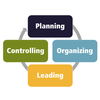
A century ago, French industrialist Henri Fayol originally identified five elements as the basic functions of management, but today, there are now four generally accepted functions of management: planning, organizing, leading and controlling. These functions work together in the creation, execution and realization of organizational goals. The four functions of management can be considered a process where each function builds on the previous function. To be successful, management needs to follow the four functions of management in the proper order.
Managers first need to develop a plan, then organize their resources and delegate responsibilities to employees according to the plan, then lead others to efficiently carry out the plan, and finally evaluate the plan’s effectiveness as it is being executed and make any necessary adjustments.
- Planning
- Organizing
- Leading
- Controlling
In the planning stage, managers establish organizational goals and create a course of action to achieve them. During the planning phase, management makes strategic decisions to set a direction for the organization. Managers can brainstorm different alternatives to achieve the objective before choosing the best course of action. While planning, managers typically conduct in-depth analysis of the organization’s current state of affairs, taking into consideration its vision and mission and evaluating what resources are available to meet organizational objectives.
While planning, managers usually evaluate internal and external factors that may affect the execution of the plan, such as economic growth, customers and competitors. They also establish a realistic timeline for achieving the goal or goals based on the organization’s available finances, personnel and resources. Managers may have to take additional steps, such as seeking approval from other departments, executives or their board of directors before proceeding with the plan.
Strategic planning: This type of planning is often carried out by an organization’s top management and usually creates goals for the entire organization. It analyzes threats to the organization, evaluates the organization’s strengths and weaknesses and creates a plan of how the organization can best compete in its environment. Strategic planning usually has a long timeframe of three years or more.
Tactical planning: Tactical planning is the shorter-term planning of an objective that will take a year or less to achieve. It is usually carried out by an organization’s middle management. Tactical planning is usually aimed at a specific area or department of the organization such as its facilities, production, finance, marketing or personnel.
Operational planning: Operational planning is the process of using tactical planning to achieve strategic planning and goals. Operational planning creates a timeframe for putting a portion of the strategic goal into practice operationally.
The purpose of organizing is to distribute the resources and delegate tasks to personnel to achieve the goals established in the planning stage. Managers may need to work with other departments of the organization, such as finance and human resources, to organize the budget and staffing. During the organizing stage, managers strive to create a work environment conducive to productivity. Managers typically take employees’ motivation and aptitude into account to match employees with roles and tasks that best fit their abilities.
Leading consists of motivating employees and influencing their behavior to achieve organizational objectives. Leading focuses on managing people, such as individual employees, teams and groups rather than tasks. Though managers may direct team members by giving orders and directing to their team, managers who are successful leaders usually connect with their employees by using interpersonal skills to encourage, inspire and motivate team members to perform to the best of their abilities.
Managers usually incorporate different leadership styles and change their management style to adapt to different situations. Examples of situational leadership styles include:
- Directing: The manager leads by deciding with little input from the employee. This is an effective leadership style for new employees who need a lot of initial direction and training.
- Coaching: The manager is more receptive to input from employees. They may pitch their ideas to employees to work cooperatively and build trust with team members. This style of leadership is effective for individuals who need managerial support to further develop their skills.
- Supporting: The manager decides with team members but focuses more on building relationships within the team. This style of leadership is effective for employees who have fully developed skills but are sometimes inconsistent in their performance.
- Delegating: The leader provides a minimum of guidance to employees and is more concerned with the vision of the project than day-to-day operations. This style of leadership is effective with employees able to work and perform tasks on their own with little guidance. The leader can focus more on high-level goals than on tasks.
Controlling is the process of evaluating the execution of the plan and making adjustments to ensure that the organizational goal is achieved. During the controlling stage, managers perform tasks such as training employees as necessary and managing deadlines. Managers monitor employees and evaluate the quality of their work. They can conduct performance appraisals and give employees feedback, providing positive remarks on what they are doing well and suggestions for improvement. They may also offer pay raise incentives to high-performing employees.