
Product attributes


Other attributes

The r1 is a custom-built consumer artificial intelligence (AI) device developed by rabbit Inc. that performs everyday digital tasks. The r1 is a handheld touchscreen device that interacts with apps for the user, simplifying how they interact with technology. The device can perform a range of tasks through a single interface, including controlling music, ordering a car, buying groceries, sending messages, and more. Users interact with the r1 via voice commands or an on-screen interface with a series of category-based cards, for example, for music, transportation, video chats, or other tasks and services.
The r1 was announced on January 9, 2024, at CES in a keynote presentation by rabbit CEO and founder Jesse Lyu. The device was made available for preorder on January 9, 2024, and is expected to start shipping to US customers in March–April 2024.
Introducing r1 - Rabbit r1 Keynote Presentation, CES January 9, 2024
The r1 runs the company's rabbit OS operating system, which offers a new way of interfacing with machines. Rabbit OS aims to move users toward an app-free online experience, creating a new and more efficient way of interacting with devices.
Rabbit OS is built on the Large Action Model (LAM), a proprietary AI foundation model developed by rabbit that is trained by humans interacting with popular apps like Spotify and Uber, teaching it how to perform similar tasks. Rabbit states LAM can:
infer and model human actions on computer interfaces by learning users’ intention and behavior when they use specific apps, and then mimic and perform them both reliably and quickly.
LAM is designed to interact with apps in the same way humans do. It learns by demonstration, observing a human using an interface, and replicating the process, even if the interface is changed. It utilizes mobile and desktop environments on a customized cloud platform to interact with apps within the platform, performing tasks for the user without the need for custom integrations like application programming interfaces (APIs). It aims to remove the need for users to download and use multiple apps on their devices.
Rabbit OS uses personal AI agents, what the company calls "rabbits," to carry out tasks. The operating system can handle more complex tasks compared to most voice-based assistants. Examples include thoroughly researching and booking options for upcoming travel or filling a virtual grocery store cart and completing transactions at check-out. At launch, rabbit OS on the r1 is trained to work on most popular apps, and the company plans to add capabilities for niche apps and workflows. Rabbit OS also has a dedicated training mode, where users can teach the r1 how to perform a task, with the company stating it will be able to repeat the action on its own in the future. Users access their existing apps using Rabbit OS's web portal called “rabbit hole,” a cloud hub where users can relay access and enable different features and functionalities for their r1 device.
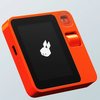
The r1 was designed in collaboration with Teenage Engineering. Rabbit states the design is inspired by retro gadgets like the Tamagotchi. It is roughly the size of a stack of Post-It notes and is available in an orange color. The device features a touchscreen display, a push-to-talk button, a scroll-wheel, and a motorized vision system that serves as a rotating camera that the company calls the “rabbit eye.” The r1's vision system can be used for video calls and computer vision applications. The r1 is intended to be a fully standalone device and has both Wi-Fi and cellular connectivity options. The r1 is powered by a rechargeable lithium battery that is charged using a USB-C charge cable and power adapter. Battery life depends on many factors, including usage and the external environment. However, rabbit states the battery is designed to last for all-day usage.

Rabbit r1 device.
The r1 weighs 115 grams with a 2.88-inch display. It is powered by a 2.3 GHz MediaTek Helio P35 processor and comes with 4 GB of memory and 128 GB of storage, a USB-C port, and an empty SIM card slot, which is factory unlocked.
Rabbit states it does not store any user credentials of any third-party services. Authentication processes happen on the destination services’ login systems, and users have control to link and unlink services to rabbit OS. Users have the option to delete their stored data at any time and will also be aware of and have control over which types of actions are being delegated to the rabbits. The r1 does not have an “always listening mode,” and the microphone of r1 does not record unless the user presses the push-to-talk (PTT) button. The device's rotating camera defaults to a position that physically blocks the lens unless the user explicitly requests it.
Preorders for the r1 opened upon the announcement on January 9, 2024. At the launch, pricing for the r1 starts at $199 without any subscriptions, without taxes, shipping fees, and duties for international orders. This price also does not include any accessories, such as a charging cable. Customers can only order a maximum of five units. The r1 is available in the United States, Canada, the United Kingdom, certain countries of the European Union (Denmark, France, Germany, Ireland, Italy, Netherlands, Spain, Sweden), South Korea, and Japan. Rabbit stated it expects to begin shipping r1s to US addresses in March–April 2024 and international orders later in 2024. On January 10, 2024, rabbit announced the company had sold 10,000 units in twenty-four hours, selling out its first batch. The company announced a second batch available for preorder with an expected delivery date of April–May 2024.