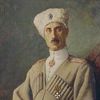
Pyotr Nikolayevich Wrangel - Russian military commander, participant of the Russo—Japanese and World War I wars, one of the main leaders of the "White Movement" during the Civil War. Commander-in-Chief of the Russian Army in Crimea and Poland (1920).
In 1900, Wrangel completed his studies at the Mining Institute in St. Petersburg, received an engineering diploma and a gold medal. In 1901, he was called up for military service. The service takes place in the Life Guards cavalry regiment in the status of a volunteer. Performs the duties of an official of special assignments under the Governor-General of Irkutsk.
He retires with the rank of cornet. In 1902, he entered the Nikolaev Cavalry School in St. Petersburg. For bravery and participation in combat operations in the Russian-Japanese War of 1904-1905, he was awarded the Anninsky weapon. In 1907, he was presented to the emperor and transferred to his native regiment. He continues his studies at the Mykolaiv Guards Academy and graduated from it in 1910.
At the beginning of the First World War, he was already a captain of the Horse Guards. In the first battles, he distinguished himself by capturing a German battery in a fierce attack under the Hood on August 23. Among the first officers, he was awarded the Order of St. George of the 4th degree, and on October 12, 1914, he received the rank of colonel.

Pyotr Wrangel
In the autumn of 1915, he was sent to the Southwestern Front by the commander of the 1st Nerchinsk Regiment of Trans-Baikal Cossacks. Wrangel did not climb the corporate ladder very quickly, but he deserved it. Often his interlocutor was Nicholas II, with whom they talked for a long time on topics of concern to them.
Unlike Denikin, Kornilov and many colleagues, Wrangel did not support the February Revolution and the Provisional Government. He believed that revolutionary decrees and government actions undermine the basis of the army. He held an insignificant position and turned out to be an outsider in this political struggle.
He fought for discipline and opposed the elected soldiers' committees. He tried to prove that the abdication of Nicholas II would worsen the situation in the country. Kerensky wanted to involve him in the defense of Petrograd, but he resigned. After the revolution, Wrangel reunited with his family, who at that time settled in the Crimea.
In February 1918, the baron was arrested by sailors of the Black Sea Fleet. His wife's intercession saves him from being shot. During the occupation of Ukraine by German troops, a meeting of Wrangel and Hetman Skoropadsky, who had previously been colleagues, took place in Kiev.

Pyotr Wrangel during in the Civil War
Pyotr Nikolaevich was disappointed by the Ukrainian nationalists surrounding Skoropadsky, as well as his dependence on the Germans. He goes to the Kuban and joins General Denikin, who instructs him to curb one rebellious Cossack division. Wrangel not only calmed the Cossacks, but also created a unit with excellent discipline.
In the winter of 1918-1919, he led the Caucasian Army, occupied the Kuban and Terek basins, Rostov-on-Don, and in June 1919 took Tsaritsyn. Wrangel's victories confirm his talent. When conducting military operations, he maximally limited the violence inevitable in such conditions, severely punished for looting and looting. At the same time, the soldiers respected him very much.
In the summer of 1919, three armies of Denikin moved to Moscow, one of them commanded by Wrangel. His army advanced through Nizhny Novgorod and Saratov, but suffered heavy losses during the capture of Tsaritsyn. Wrangel criticized Denikin's plan and considered it a losing one. He was convinced that the offensive against Moscow had to be conducted on one front.
As a result, the troops were defeated by the Red Army. To prevent a catastrophe, Wrangel was sent to Kharkov, but upon arrival there he only made sure that the White Army was destroyed. An attempt to plot against Denikin failed, and Wrangel was again sent to the Kuban.
In March 1920, the White Army suffered new losses, as a result of which it barely managed to cross to the Crimea. Denikin was blamed for the defeat. In April, after his resignation, Wrangel becomes the new commander-in-chief. The "Russian Army" is the name given to the white forces that continued the struggle against the Bolsheviks.
Wrangel is looking not only for a military solution to the problems, but also for a political one. A provisional republican government was created in Crimea to unite the people who were disillusioned with the Bolsheviks. Wrangel's political program included theses about the land that should belong to the people and provided employment guarantees for the population.
At that time, the white movement no longer received the support of the British, but Wrangel independently reorganized the army, numbering about 25 thousand soldiers. He hoped that the war of the Council of People's Commissars with Pilsudski's Poland would distract the forces of the Reds, and he would be able to strengthen his positions in the Crimea, after which he would launch a counteroffensive.
The attack of the Reds on April 13 on the Perekop Isthmus was easily repulsed. Wrangel went on the attack, reached Melitopol and seized the lands adjacent to the peninsula from the north. In July, a new Bolshevik offensive was repelled, but in September, after the end of the war with Poland, the Communists sent reinforcements to the Crimea.
The number of Red Army troops was 100 thousand infantry units and 33 thousand 600 cavalry units. The forces of the Bolsheviks were four times greater than the forces of the Whites. We had to retreat beyond the Perekop Isthmus. The first attempt of the Reds to break through was stopped, but Wrangel realized that the offensive would resume. It was decided to prepare for evacuation.

Monument to Pyotr Wrangel
For seven months General Wrangel was at the head of the Crimea – the last stronghold of the Russian land free from the Bolsheviks. On November 7, 1920, troops under the command of Frunze broke into the Crimea. The civilian population was evacuated under the cover of the defense of Perekop. While the pressure of the enemy was restrained by the troops of General Kutepov, Wrangel was engaged in the evacuation of the population. Boarding for 126 ships was organized in five Black Sea ports.
Within three days, 146 thousand people were evacuated, including 70 thousand soldiers. The French battleship Waldeck-Rousseau was sent to help refugees who were going to Turkey, Yugoslavia, Bulgaria, Greece and Romania. Pyotr Nikolaevich ended up in Istanbul, then he settled in Belgrade. He led the white movement of emigrants, in 1924 he gave up leadership, handing it over to Grand Duke Nikolai Nikolaevich.