Other attributes
Psilocybe cubensis is a species of psychedelic mushroom whose principal active compounds are psilocybin and psilocin. Commonly called shrooms, magic mushrooms, golden halos, cubes, or gold caps, it belongs to the fungus family Hymenogastraceae and was previously known as Stropharia cubensis. It is the most well known psilocybin mushroom due to its wide distribution and ease of cultivation.

The species was first described in 1906 as Stropharia cubensis by American mycologist Franklin Sumner Earle in Cuba. In 1907 it was identified as Naematoloma caerulescens in Tonkin (now northern Vietnam) by French pharmacist and mycologist Narcisse Théophile Patouillard, while in 1941 it was called Stropharia cyanescens by William Alphonso Murrill near Gainesville in Florida. German-born mycologist Rolf Singer moved the species into the genus Psilocybe in 1949, giving it the binomial name Psilocybe cubensis. The synonyms were later also assigned to the species Psilocybe cubensis.
The name Psilocybe is derived from the Ancient Greek roots psilos (ψιλος) and kubê (κυβη), and translates as "bare head". Cubensis means "coming from Cuba", and refers to the type locality published by Earle.
Singer divided P. cubensis into three varieties: the nominate, which usually had a brownish cap, Murrill's cyanescens from Florida, which generally had a pale cap, and var caeurulascens from Indochina with a more yellowish cap.
Psilocybe cubensis is commonly known as gold top, golden top or gold cap in Australia, and San Ysidro or Palenque mushroom in the United States and Mexico, while the term "magic mushroom" has been applied to hallucinogenic mushrooms in general. A common name in Thai is "Hed keequai", which translates as "mushroom which appears after water buffalo defecates
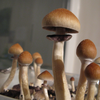
The cap is 1.6–8 cm (0.6–3.1 in), conic to convex with a central papilla when young, becoming broadly convex to plane with age, retaining a slight umbo sometimes surrounded by a ring-shaped depression. The cap surface is smooth and sticky, sometimes with white universal veil remnants attached. The cap is brown becoming paler to almost white at the margin, and fades to more golden-brown or yellowish with age. When bruised, all parts of the mushroom stain blue. The narrow grey gills are adnate to adnexed, sometimes seceding attachment, and darken to purplish-black and somewhat mottled with age. The gill edges remain whitish. The hollow white stipe is 4–15 cm (2–6 in) high by 0.4–1.4 cm (0.2–0.6 in) thick, becoming yellowish in age. The well-developed veil leaves a persistent white membranous ring whose surface usually becomes the same color as the gills because of falling spores. The mushroom has no odor, and tastes farinaceous. The spores are 11.5–17.3 x 8–11.5 µm, sub ellipsoid, basidia 4-spored but sometimes 2- or 3-, pleurocystidia and cheilocystidia present.
The related species Psilocybe subcubensis—found in tropical regions—is indistinguishable but has smaller spores.

Psilocybe cubensis spores
Singer noted that Psilocybe cubensis had psychoactive properties in 1949. In Australia, use of psychoactive mushrooms grew rapidly between 1969 and 1975.
In a 1992 paper, locals and tourists in Thailand were reported to consume P. cubensis and related species in mushroom omelettes—particularly in Ko Samui and Ko Pha-ngan. At times, omelettes were adulterated with LSD, resulting in prolonged intoxication. A thriving subculture had developed in the region. Other localities, such as Hat Yai, Ko Samet and Chiang Mai, also had some reported usage.
Cubensis is probably the most widely known of the psilocybin-containing mushrooms used for triggering psychedelic experiences after ingestion. Its major psychoactive compounds are:
- Psilocybin (4-phosphoryloxy-N,N-dimethyltryptamine)
- Psilocin (4-hydroxy-N,N-dimethyltryptamine)
- Baeocystin (4-phosphoryloxy-N-methyltryptamine)
- Norbaeocystin (4-phosphoryloxytryptamine)
The concentrations of psilocin and psilocybin, as determined by high-performance liquid chromatography, are in the range of 0.14–0.42% and 0.37–1.30% (dry weight) in the whole mushroom, 0.17–0.78% and 0.44–1.35% in the cap, and 0.09 and 0.30%/0.05–1.27% in the stem, respectively.
Individual brain chemistry and psychological predisposition play a significant role in determining appropriate doses. For a modest psychedelic effect, a minimum of one gram of dried Psilocybe cubensis mushrooms is ingested orally, 0.25–1 gram is usually sufficient to produce a mild effect, 1–2.5 grams usually provides a moderate effect, and 2.5 grams and higher usually produces strong effects. For most people, 3.5 dried grams (1/8 oz) would be considered a high dose and may produce an intense experience; this is, however, typically considered a standard dose among recreational users. For many individuals, doses above three grams may be overwhelming. For a few rare people, doses as small as 0.25 gram can produce full-blown effects normally associated with very high doses. For most people, however, that dose level would result in virtually no effects. Due to factors such as age and storage method, the psilocybin content of a given sample of mushrooms will vary. Effects usually start after approximately 20–60 minutes (depending on method of ingestion and stomach contents) and may last from four to ten hours, depending on dosage.
The effects of very high doses can be overwhelming depending on the particular phenotype of cubensis, grow method, and the individual. It is recommended not to eat wild mushrooms without properly identifying them as they may be poisonous. In particular, similar species include mushrooms of the genus Galerina and Pholiotina rugosa—all potentially deadly—and Chlorophyllum molybdites. All of these grow in pastures—similar habitat to that preferred by P. cubensis.
In 2019, a 15-year-old boy suffered from transient kidney failure after eating P. cubensis from a cultivation kit in Canada. His two colleagues suffered no ill effects.
Psilocybin and psilocin are listed as Schedule I drugs under the United Nations 1971 Convention on Psychotropic Substances. However, mushrooms containing psilocybin and psilocin are not illegal in some parts of the world. For example, in Brazil they are legal, but extractions from the mushroom containing psilocybin and psilocin remain illegal. In the United States, growing or possessing Psilocybe cubensis mushrooms is illegal in all states, but it is legal to possess and buy the spores for microscopy purposes. However, as of May 8, 2019 Denver, Colorado has decriminalized it for those 21 and up. On June 4, 2019, Oakland, California followed suit, decriminalizing psilocybin containing mushrooms as well as the Peyote cactus. On January 29, 2020, Santa Cruz, California decriminalized naturally-occurring psychedelics, including psilocybin mushrooms. On November 3, 2020, the state of Oregon decriminalized possession of psilocybin mushrooms for recreational use and granted licensed practitioners permission to administer psilocybin mushrooms to individuals age 21 years and older.

Grow Cubensis in mototube
In 1978, the Florida Supreme Court ruled in Fiske vs Florida that possession of psilocybin mushrooms is not illegal, in that the mushrooms cannot be considered a "container" for psilocybin based on how the law is written, i.e., it does not specifically state that psilocybin mushrooms themselves are illegal, but that the hallucinogenic constituents in them are. According to this decision, the applicable statute as framed imparts no information as to which plants may contain psilocybin in its natural state, and does not advise a person of ordinary intelligence that this substance is contained in a particular variety of mushroom. The statute, therefore, can not constitutionally be applied to the appellant.
Personal-scale cultivation of Psilocybe cubensis mushrooms ranges from the relatively simple and small-scale PF Tek and other "cake" methods, that produce a limited amount of mushrooms, to advanced techniques utilizing methods of professional mushroom cultivators. These advanced methods require a greater investment of time, money, and knowledge, but reward the diligent cultivator with far larger and much more consistent harvests.
Terence and Dennis McKenna made Psilocybe cubensis particularly famous when they published Psilocybin: The Magic Mushroom Grower's Guide in the 1970s upon their return from the Amazon rainforest, having deduced new methods (based on pre-existing techniques originally described by J.P. San Antonio for growing psilocybin mushrooms and assuring their audience that Psilocybe cubensis were amongst the easiest psilocybin-containing mushrooms to cultivate.

Growing
Potency of cultivated specimens can vary widely in accordance with each flush (harvest). In a classic paper published by Jeremy Bigwood and M.W. Beug, it was shown that with each flush, psilocybin levels varied somewhat unpredictably but were much the same on the first flush as they were on the last flush; however, psilocin was typically absent in the first two flushes but peaked by the fourth flush, making it the most potent. Two strains were also analyzed to determine potency in caps and stems: In one strain the caps contained generally twice as much psilocybin as the stems, but the small amount of psilocin present was entirely in the stems. In the other strain, a trace of psilocin was present in the cap but not in the stem; the cap and stem contained equal amounts of psilocybin. The study concluded that the levels of psilocybin and psilocin vary by over a factor of four in cultures of Psilocybe cubensis grown under controlled conditions.


