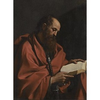


Paul[a] (born Saul of Tarsus;[b] c. 5 – c. 64/67 AD), commonly known as Paul the Apostle[8] and Saint Paul,[9] was a Christian apostle (although not one of the original Twelve Apostles) who spread the teachings of Jesus in the first-century world.[10] Generally regarded as one of the most important figures of the Apostolic Age,[9][11] he founded several Christian communities in Asia Minor and Europe from the mid-40s to the mid-50s AD.[12]
According to the New Testament book Acts of the Apostles, Paul was a Pharisee; he participated in the persecution of early disciples of Jesus, possibly Hellenised diaspora Jews converted to Christianity,[13] in the area of Jerusalem, prior to his conversion.[note 1] In the narrative of Acts, Paul was traveling on the road from Jerusalem to Damascus on a mission to "arrest them and bring them back to Jerusalem" when the risen Christ appeared to him in a great bright light. He was struck blind, but after three days his sight was restored by Ananias of Damascus and Paul began to preach that Jesus of Nazareth was the Jewish messiah and the Son of God.[14] Approximately half of the Book of Acts deals with Paul's life and works.
Fourteen of the 27 books in the New Testament have traditionally been attributed to Paul.[15] Seven of the Pauline epistles are undisputed by scholars as being authentic, with varying degrees of argument about the remainder. Pauline authorship of the Epistle to the Hebrews is not asserted in the Epistle itself and was already doubted in the 2nd and 3rd centuries.[note 2] It was almost unquestioningly accepted from the 5th to the 16th centuries that Paul was the author of Hebrews,[17] but that view is now almost universally rejected by scholars.[17][18] The other six are believed by some scholars to have come from followers writing in his name, using material from Paul's surviving letters and letters written by him that no longer survive.[10][9][note 3] Other scholars argue that the idea of a pseudonymous author for the disputed epistles raises many problems.[20]
Today, Paul's epistles continue to be vital roots of the theology, worship and pastoral life in the Latin and Protestant traditions of the West, as well as the Eastern Catholic and Orthodox traditions of the East.[21] Paul's influence on Christian thought and practice has been characterized as being as "profound as it is pervasive", among that of many other apostles and missionaries involved in the spread of the Christian faith.[10]
Names
Paul's Jewish name was "Saul" (Hebrew: שָׁאוּל, Modern: Sha'ûl, Tiberian: Šāʼûl), perhaps after the biblical King Saul, the first king of Israel and like Paul a member of the Tribe of Benjamin; the Latin name Paul, meaning small, was not a result of his conversion but a second name for use in communicating with a Greco-Roman audience.[22]
According to the Book of Acts, he was a Roman citizen.[23] As such, he also bore the Latin name of "Paul" (essentially a Latin approximation of Saul) – in biblical Greek: Παῦλος (Paulos),[24] and in Latin: Paulus.[note 4][25] It was typical for the Jews of that time to have two names: one Hebrew, the other Latin or Greek.[26][27][28]
Jesus called him "Saul, Saul"[29] in "the Hebrew tongue" in the Book of Acts, when he had the vision which led to his conversion on the road to Damascus.[30] Later, in a vision to Ananias of Damascus, "the Lord" referred to him as "Saul, of Tarsus".[31] When Ananias came to restore his sight, he called him "Brother Saul".[32]
In Acts 13:9, Saul is called "Paul" for the first time on the island of Cyprus – much later than the time of his conversion.[33] The author of Luke–Acts indicates that the names were interchangeable: "Saul, who also is called Paul." He refers to him as Paul through the remainder of Luke–Acts. This was apparently Paul's preference since he is called Paul in all other Bible books where he is mentioned, including those that he authored. Adopting his Roman name was typical of Paul's missionary style. His method was to put people at their ease and to approach them with his message in a language and style to which they could relate, as in 1 Corinthians 9:19-23.[34][35]
Available sources
Further information: Historical reliability of the Acts of the Apostles
The Conversion of Saul, fresco by Michelangelo, 1542–1545
The main source for information about Paul's life is the material found in his epistles and in the Acts of the Apostles.[36] However, the epistles contain little information about Paul's pre-conversion past. The Acts of the Apostles recounts more information but leaves several parts of Paul's life out of its narrative, such as his probable but undocumented execution in Rome.[37] Some scholars believe the Acts of the Apostles to also contradict Paul's epistles on multiple accounts, in particular concerning the frequency of Paul's visits to the church in Jerusalem.[38][39]
Sources outside the New Testament that mention Paul include:
Clement of Rome's epistle to the Corinthians (late 1st/early 2nd century);
Ignatius of Antioch's epistles to the Romans and to the Ephesians[40] (early 2nd century);
Polycarp's epistle to the Philippians (early 2nd century);
Eusebius's Historia Ecclesiae (early 4th century);
The apocryphal Acts narrating the life of Paul (Acts of Paul, Acts of Paul and Thecla, Acts of Peter and Paul), the apocryphal epistles attributed to him (Epistle of the Corinthians to Paul, the Third Epistle to the Corinthians and the Correspondence of Paul and Seneca) and some apocalyptic texts attributed to him (Apocalypse of Paul and Coptic Apocalypse of Paul). These writings are all late (they are usually dated from the 2nd to the 4th century).
Biblical narrative
Early life
Geography relevant to Paul's life, stretching from Jerusalem to Rome
The two main sources of information that give access to the earliest segments of Paul's career are the Book of Acts and the autobiographical elements of Paul's letters to the early Christian communities.[36] Paul was likely born between the years of 5 BC and 5 AD.[41] The Book of Acts indicates that Paul was a Roman citizen by birth, but Helmut Koester takes issue with the evidence presented by the text.[42][43]
He was from a devout Jewish family[44] based in the city of Tarsus.[22] One of the larger centers of trade on the Mediterranean coast and renowned for its university, Tarsus had been among the most influential cities in Asia Minor since the time of Alexander the Great, who died in 323 BC.[44]
Paul referred to himself as being "of the stock of Israel, of the tribe of Benjamin, a Hebrew of the Hebrews; as touching the law, a Pharisee".[45][46] The Bible reveals very little about Paul's family. Acts quotes Paul referring to his family by saying he was "a Pharisee, born of Pharisees".[47][48] Paul's nephew, his sister's son, is mentioned in Acts 23:16.[49] In Romans 16:7, he states that his relatives, Andronicus and Junia, were Christians before he was and were prominent among the Apostles.[50]
The family had a history of religious piety.[51][note 5] Apparently, the family lineage had been very attached to Pharisaic traditions and observances for generations.[52] Acts says that he was an artisan involved in the leather crafting or tent-making profession.[53][54] This was to become an initial connection with Priscilla and Aquila, with whom he would partner in tentmaking[55] and later become very important teammates as fellow missionaries.[56]
While he was still fairly young, he was sent to Jerusalem to receive his education at the school of Gamaliel,[57][46] one of the most noted teachers of Jewish law in history. Although modern scholarship agrees that Paul was educated under the supervision of Gamaliel in Jerusalem,[46] he was not preparing to become a scholar of Jewish law, and probably never had any contact with the Hillelite school.[46] Some of his family may have resided in Jerusalem since later the son of one of his sisters saved his life there.[58][22] Nothing more is known of his biography until he takes an active part in the martyrdom of Stephen,[59] a Hellenised diaspora Jew.[60]
Although it is known (from his biography and from Acts) that Paul could and did speak Aramaic (then known as "Hebrew"),[22] modern scholarship suggests that Koine Greek was his first language.[61][62] In his letters, Paul drew heavily on his knowledge of Stoic philosophy, using Stoic terms and metaphors to assist his new Gentile converts in their understanding of the Gospel and to explain his Christology.[63][64]
Persecutor of early Christians
Main article: Conversion of Paul the Apostle
Conversion on the Way to Damascus (1601), by Caravaggio
Paul says that prior to his conversion,[65] he persecuted early Christians "beyond measure", more specifically Hellenised diaspora Jewish members who had returned to the area of Jerusalem.[66][note 1] According to James Dunn, the Jerusalem community consisted of "Hebrews," Jews speaking both Aramaic and Greek, and "Hellenists," Jews speaking only Greek, possibly diaspora Jews who had resettled in Jerusalem.[67] Paul's initial persecution of Christians probably was directed against these Greek-speaking "Hellenists" due to their anti-Temple attitude.[68] Within the early Jewish Christian community, this also set them apart from the "Hebrews" and their continuing participation in the Temple cult.[68]
Conversion
Paul's conversion can be dated to 31–36[69][70][71] by his reference to it in one of his letters. In Galatians 1:16, Paul writes that God "was pleased to reveal his son to me."[72] In 1 Corinthians 15:8, as he lists the order in which Jesus appeared to his disciples after his resurrection, Paul writes, "last of all, as to one untimely born, He appeared to me also."[73]
According to the account in the Book of Acts, it took place on the road to Damascus, where he reported having experienced a vision of the ascended Jesus. The account says that "He fell to the ground and heard a voice saying to him, 'Saul, Saul, why do you persecute me?' He asked, 'Who are you, Lord?' The reply came, 'I am Jesus, whom you are persecuting'."[74]
The Conversion of Saint Paul on the Way to Damascus (c. 1889), by José Ferraz de Almeida Júnior
According to the account in Acts 9:1-22, he was blinded for three days and had to be led into Damascus by the hand.[75] During these three days, Saul took no food or water and spent his time in prayer to God. When Ananias of Damascus arrived, he laid his hands on him and said: "Brother Saul, the Lord, [even] Jesus, that appeared unto thee in the way as thou camest, hath sent me, that thou mightest receive thy sight, and be filled with the Holy Ghost."[76] His sight was restored, he got up and was baptized.[77] This story occurs only in Acts, not in the Pauline epistles.[78]
The author of the Book of Acts may have learned of Paul's conversion from the church in Jerusalem, or from the church in Antioch, or possibly from Paul himself.[79]
According to Timo Eskola, early Christian theology and discourse was influenced by the Jewish Merkabah tradition.[80] Similarly, Alan Segal and Daniel Boyarin regard Paul's accounts of his conversion experience and his ascent to the heavens as the earliest first-person accounts we have of a Merkabah mystic in Jewish or Christian literature. Conversely, Timothy Churchill has argued that Paul's Damascus road encounter does not fit the pattern of Merkabah.[81]
Post-conversion
Caravaggio (1571–1610), The Conversion of Saint Paul, 1600
Apostle Paul, by Rembrandt c. 1633
Apostle Paul, by Rembrandt c. 1657
According to Acts,
And immediately he proclaimed Jesus in the synagogues, saying, "He is the Son of God." And all who heard him were amazed and said, "Is not this the man who made havoc in Jerusalem of those who called upon this name? And has he not come here for this purpose, to bring them bound before the chief priests?" But Saul increased all the more in strength, and confounded the Jews who lived in Damascus by proving that Jesus was the Christ.
— Acts 9:20–22[82]
Early ministry
The house believed to be of Ananias of Damascus in Damascus
Bab Kisan, believed to be where Paul escaped from persecution in Damascus
After his conversion, Paul went to Damascus, where Acts 9 states he was healed of his blindness and baptized by Ananias of Damascus.[83] Paul says that it was in Damascus that he barely escaped death.[84] Paul also says that he then went first to Arabia, and then came back to Damascus.[85][86] Paul's trip to Arabia is not mentioned anywhere else in the Bible, and some suppose he actually traveled to Mount Sinai for meditations in the desert.[87][88] He describes in Galatians how three years after his conversion he went to Jerusalem. There he met James and stayed with Simon Peter for 15 days.[89] Paul located Mount Sinai in Arabia in Galatians 4:24–25.[90]
Paul asserted that he received the Gospel not from man, but directly by "the revelation of Jesus Christ".[91] He claimed almost total independence from the Jerusalem community[92] (possibly in the Cenacle), but agreed with it on the nature and content of the gospel.[93] He appeared eager to bring material support to Jerusalem from the various growing Gentile churches that he started. In his writings, Paul used the persecutions he endured to avow proximity and union with Jesus and as a validation of his teaching.
Paul's narrative in Galatians states that 14 years after his conversion he went again to Jerusalem.[94] It is not known what happened during this time, but both Acts and Galatians provide some details.[95] Though a view is held that Paul spent 14 years studying the scriptures and growing in the faith. At the end of this time, Barnabas went to find Paul and brought him to Antioch.[96][97] The Christian community at Antioch had been established by Hellenised diaspora Jews living in Jerusalem, who played an important role in reaching a Gentile, Greek audience, notably at Antioch, which had a large Jewish community and significant numbers of Gentile "God-fearers."[98] From Antioch the mission to the Gentiles started, which would fundamentally change the character of the early Christian movement, eventually turning it into a new, Gentile religion.[99]
When a famine occurred in Judea, around 45–46,[100] Paul and Barnabas journeyed to Jerusalem to deliver financial support from the Antioch community.[101] According to Acts, Antioch had become an alternative center for Christians following the dispersion of the believers after the death of Stephen. It was in Antioch that the followers of Jesus were first called "Christians".[102]
First missionary journey
The author of Acts arranges Paul's travels into three separate journeys. The first journey,[103] for which Paul and Barnabas were commissioned by the Antioch community,[104] and led initially by Barnabas,[note 6] took Barnabas and Paul from Antioch to Cyprus then into southern Asia Minor, and finally returning to Antioch. In Cyprus, Paul rebukes and blinds Elymas the magician[105] who was criticizing their teachings.
They sailed to Perga in Pamphylia. John Mark left them and returned to Jerusalem. Paul and Barnabas went on to Pisidian Antioch. On Sabbath they went to the synagogue. The leaders invited them to speak. Paul reviewed Israelite history from life in Egypt to King David. He introduced Jesus as a descendant of David brought to Israel by God. He said that his team came to town to bring the message of salvation. He recounted the story of Jesus' death and resurrection. He quoted from the Septuagint[106] to assert that Jesus was the promised Christos who brought them forgiveness for their sins. Both the Jews and the "God-fearing" Gentiles invited them to talk more next Sabbath. At that time almost the whole city gathered. This upset some influential Jews who spoke against them. Paul used the occasion to announce a change in his mission which from then on would be to the Gentiles.[107]
Antioch served as a major Christian home base for Paul's early missionary activities,[5] and he remained there for "a long time with the disciples"[108] at the conclusion of his first journey. The exact duration of Paul's stay in Antioch is unknown, with estimates ranging from nine months to as long as eight years.[109]
In Raymond Brown's An Introduction to the New Testament (1997), a chronology of events in Paul's life is presented, illustrated from later 20th-century writings of biblical scholars.[110] The first missionary journey of Paul is assigned a "traditional" (and majority) dating of 46–49 AD, compared to a "revisionist" (and minority) dating of after 37 AD.[111]
Council of Jerusalem
Main article: Council of Jerusalem
See also: Circumcision controversy in early Christianity
A vital meeting between Paul and the Jerusalem church took place in the year 49 by "traditional" (and majority) dating, compared to a "revisionist" (and minority) dating of 47/51.[112] The meeting is described in Acts 15:2[113] and usually seen as the same event mentioned by Paul in Galatians 2:1.[114][37] The key question raised was whether Gentile converts needed to be circumcised.[115][116] At this meeting, Paul states in his letter to the Galatians, Peter, James, and John accepted Paul's mission to the Gentiles.
The Jerusalem meetings are mentioned in Acts, and also in Paul's letters.[117] For example, the Jerusalem visit for famine relief[118] apparently corresponds to the "first visit" (to Peter and James only).[119][117] F. F. Bruce suggested that the "fourteen years" could be from Paul's conversion rather than from his first visit to Jerusalem.[120]
Incident at Antioch
Main article: Incident at Antioch
Despite the agreement achieved at the Council of Jerusalem, Paul recounts how he later publicly confronted Peter in a dispute sometimes called the "Incident at Antioch", over Peter's reluctance to share a meal with Gentile Christians in Antioch because they did not strictly adhere to Jewish customs.[115]
Writing later of the incident, Paul recounts, "I opposed [Peter] to his face, because he was clearly in the wrong", and says he told Peter, "You are a Jew, yet you live like a Gentile and not like a Jew. How is it, then, that you force Gentiles to follow Jewish customs?"[121] Paul also mentions that even Barnabas, his traveling companion and fellow apostle until that time, sided with Peter.[115]
The final outcome of the incident remains uncertain. The Catholic Encyclopedia suggests that Paul won the argument, because "Paul's account of the incident leaves no doubt that Peter saw the justice of the rebuke".[115] However Paul himself never mentions a victory and L. Michael White's From Jesus to Christianity draws the opposite conclusion: "The blowup with Peter was a total failure of political bravado, and Paul soon left Antioch as persona non grata, never again to return".[122]
The primary source account of the Incident at Antioch is Paul's letter to the Galatians.[121]
Second missionary journey
Saint Paul delivering the Areopagus sermon in Athens, by Raphael, 1515. This sermon addressed early issues in Christology.[123][124]
Paul left for his second missionary journey from Jerusalem, in late Autumn 49,[125] after the meeting of the Council of Jerusalem where the circumcision question was debated. On their trip around the Mediterranean Sea, Paul and his companion Barnabas stopped in Antioch where they had a sharp argument about taking John Mark with them on their trips. The book of Acts said that John Mark had left them in a previous trip and gone home. Unable to resolve the dispute, Paul and Barnabas decided to separate; Barnabas took John Mark with him, while Silas joined Paul.
Paul and Silas initially visited Tarsus (Paul's birthplace), Derbe and Lystra. In Lystra, they met Timothy, a disciple who was spoken well of, and decided to take him with them. Paul and his companions, Silas and Timothy, had plans to journey to the southwest portion of Asia Minor to preach the gospel but during the night, Paul had a vision of a man of Macedonia standing and begging him to go to Macedonia to help them. After seeing the vision, Paul and his companions left for Macedonia to preach the gospel to them.[126] The Church kept growing, adding believers, and strengthening in faith daily.[127]
In Philippi, Paul cast a spirit of divination out of a servant girl, whose masters were then unhappy about the loss of income her soothsaying provided.[128] They seized Paul and Silas and dragged them into the marketplace before the authorities and Paul and Silas were put in jail. After a miraculous earthquake, the gates of the prison fell apart and Paul and Silas could have escaped but remained; this event led to the conversion of the jailor.[129] They continued traveling, going by Berea and then to Athens, where Paul preached to the Jews and God-fearing Greeks in the synagogue and to the Greek intellectuals in the Areopagus. Paul continued from Athens to Corinth.
Interval in Corinth
Around 50–52, Paul spent 18 months in Corinth. The reference in Acts to Proconsul Gallio helps ascertain this date (cf. Gallio Inscription).[37] In Corinth, Paul met Priscilla and Aquila,[130] who became faithful believers and helped Paul through his other missionary journeys. The couple followed Paul and his companions to Ephesus, and stayed there to start one of the strongest and most faithful churches at that time.[131]
In 52, departing from Corinth, Paul stopped at the nearby village of Cenchreae to have his hair cut off, because of a vow he had earlier taken.[132] It is possible this was to be a final haircut prior to fulfilling his vow to become a Nazirite for a defined period of time.[133] With Priscilla and Aquila, the missionaries then sailed to Ephesus[134] and then Paul alone went on to Caesarea to greet the Church there. He then traveled north to Antioch, where he stayed for some time (Greek: ποιησας χρονον, perhaps about a year), before leaving again on a third missionary journey.[citation needed] Some New Testament texts[note 7] suggest that he also visited Jerusalem during this period for one of the Jewish feasts, possibly Pentecost.[135] Textual critic Henry Alford and others consider the reference to a Jerusalem visit to be genuine[136] and it accords with Acts 21:29,[137] according to which Paul and Trophimus the Ephesian had previously been seen in Jerusalem.
Third missionary journey
The Preaching of Saint Paul at Ephesus by Eustache Le Sueur (1649)[138]
According to Acts, Paul began his third missionary journey by traveling all around the region of Galatia and Phrygia to strengthen, teach and rebuke the believers. Paul then traveled to Ephesus, an important center of early Christianity, and stayed there for almost three years, probably working there as a tentmaker,[139] as he had done when he stayed in Corinth. He is claimed to have performed numerous miracles, healing people and casting out demons, and he apparently organized missionary activity in other regions.[37] Paul left Ephesus after an attack from a local silversmith resulted in a pro-Artemis riot involving most of the city.[37] During his stay in Ephesus, Paul wrote four letters to the church in Corinth.[140] The Jerusalem Bible suggests that the letter to the church in Philippi was also written from Ephesus.[141]
Paul went through Macedonia into Achaea[142] and stayed in Greece, probably Corinth, for three months[142] during 56–57 AD.[37] Commentators generally agree that Paul dictated his Epistle to the Romans during this period.[143] He then made ready to continue on to Syria, but he changed his plans and traveled back through Macedonia because of some Jews who had made a plot against him. In Romans 15:19,[144] Paul wrote that he visited Illyricum, but he may have meant what would now be called Illyria Graeca,[145] which was at that time a division of the Roman province of Macedonia.[146] On their way back to Jerusalem, Paul and his companions visited other cities such as Philippi, Troas, Miletus, Rhodes, and Tyre. Paul finished his trip with a stop in Caesarea, where he and his companions stayed with Philip the Evangelist before finally arriving at Jerusalem.[147]
Journey from Rome to Spain
Among the writings of the early Christians, Pope Clement I said that Paul was "Herald (of the Gospel of Christ) in the West", and that "he had gone to the extremity of the west".[148] John Chrysostom indicated that Paul preached in Spain: "For after he had been in Rome, he returned to Spain, but whether he came thence again into these parts, we know not".[149] Cyril of Jerusalem said that Paul, "fully preached the Gospel, and instructed even imperial Rome, and carried the earnestness of his preaching as far as Spain, undergoing conflicts innumerable, and performing Signs and wonders".[150] The Muratorian fragment mentions "the departure of Paul from the city [of Rome] [5a] (39) when he journeyed to Spain".[151]
Visits to Jerusalem in Acts and the epistles
This table is adapted from White, From Jesus to Christianity.[117] Note that the matching of Paul's travels in the Acts and the travels in his Epistles is done for the reader's convenience and is not approved of by all scholars.