
Technology attributes
Other attributes
It has been used in automobile transmissions as an alternative to a mechanical clutch.
It also has widespread application in marine and industrial machine drives, where variable speed operation and controlled start-up without shock loading of the power transmission system is essential.
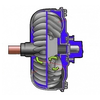
A torque converter is a type of fluid coupling that transfers rotating power from a prime mover, like an internal combustion engine, to a rotating driven load. In a vehicle with an automatic transmission, the torque converter connects the power source to the load. It is usually located between the engine's flexplate and the transmission. The equivalent location in a manual transmission would be the mechanical clutch.

During 1930 The Daimler Company of Coventry, England began to introduce a transmission system using a fluid coupling and Wilson self-changing gearbox for buses and their flagship cars.
The first diesel locomotives using fluid couplings were also produced in the 1930s
In 1939 General Motors Corporation introduced Hydramatic drive, the first fully automatic automotive transmission system installed in a mass-produced automobile.