Other attributes
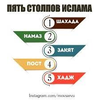
The five pillars of Islam are the core beliefs that all Muslims believe in. They are:

Muhammad ﷺ said, "The luckiest person who will have my intercession on the Day of Resurrection will be the one who said sincerely from the bottom of his heart
‘None has the right to be
worshipped but Allah,"
Bukhari
The first of the Five Pillars of Islam belief in one God. The shahada is the Muslim profession of faith, expressing the simple, fundamental belief in this pillar and what makes one a Muslim. Those who wish to enter the fold of Islam must not only speak these words but also believe it in their heart. The shahada is said as follows (and listen below):
"Esh hadu en la ilaha illaAllah, wa esh hadu anna Muhammaddun 'abduhu wa rasuloo."
which means:
"I bear witness that there is no god but God, and I bear witness that Muhammad is his messenger."
Sincere recitation of the shahada is the sole requirement for those who wish to join Islam. It represents acceptance not only of Allah and his final Prophet Muhammad ﷺ , but of the entirety of Islam.
Recitation of the shahada can vary slightly, depending if you add the words "I bear witness..." or omit it, or sometimes one says the meaning that Muhammad "is his prophet" in place of "his messenger"; although the wording may vary, semantics remain the same. See How to Convert to Islam.

The Prophet ﷺ said, “The likeness of a person who has missed one salah (prayer) is as the likeness of one who has lost all of his family and wealth,”
(Nisai and Ahmad).
Only Allah the Most High is worthy of worship and to Him is due all praise. Prayer's main function is worship of our Creator, which is why Allah created mankind. Regarding prayer, the Qur’an 2:277 translates: “Truly those who believe, and do deeds of righteousness, and perform As-Salat (prayer), and give Zakat (charity), they will have their reward with their Lord. On them shall be no fear, nor shall they grieve.”
Five daily prayers at fixed times are required worship, and by the example of the Prophet ﷺ , there are numerous other times at which it is recommended to offer prayers (these are called Sunnah prayers, because it was the habit of RasulAllah ﷺ .
Prerequisite: Purity
Before praying, Muslims must make ablutions, or purifications, which we call wudoo. This cleanses the body from impurities and makes one fit for formal prayer.
The Compulsory Prayers (Required)
Every Muslim is required to offer a minimum of five daily prayers to be offered at set times. Each prayer is essentially the same, but vary in the number of Ruk'ah (one cycle of standing, bowing and prostrations in prayer) offered. The prayers are
1) Fajr-- at daybreak and before sunrise; 2 Ruk'ah
2) Dhuhr-- given at mid-day; 4 Ruk'ah
3) Asr--afternoon prayer; 4 Ruk'ah
4) Maghrib--given just after sunset, 3 Ruk'ah
5) Isha--given at the night time; 4 Ruk'ah

Qiblah
When Muslims pray, they face toward the qiblah, which is the direction of prayer. Geographically, Muslims are facing the Ka'bah when they face the qiblah. The Ka’bah is the black cube-shaped structure built by the Prophet Ibrahim (AS) and his son. It is located in the city of Mecca in what is now known as the Kingdom of Saudi Arabia. The Ka'bah is the focal point at which Muslims are commanded to direct their prayer. The qiblah is different for each point on the globe, although for the same general region it will be about the same directionally. The city of Mecca is unique in that it is only place on the globe that will have a vastly different qiblah; praying in congregation at Masjid Al-Haram is in a circular formation around the Ka'bah
Athan and Iqamah
Before each prayer, athan (the call to prayer) is recited. It is recited the same for each prayer except at fajr (at daybreak) some additional words are added meaning "prayer is better than sleep."
The iqamah (i-QA-ma), which is almost identical to athan, is recited again just before the prayer commences. The words are the same as the athan except with the addition of words which mean "Stand for prayer"; also this recitation is generally given quickly and in a monotone voice. Recitation of iqamah signals to the worshipers that they should stand in their prayer rows, straighten them, etc., the prayer will commence now.
Hadith of the Prophet Muhammad ﷺ reported by Abu Huraira, relating to the Athan:
The Prophet ﷺ said "When the call to prayer is made, Satan runs back and breaks wind so as not to hear the call being made, and when the call is finished, he turns round. When Iqama is proclaimed, he turns his back, and when it is finished he turns round to distract a man, saying 'Remember such and such; remember such and such,' referring to something the man did not have in his mind, with the result that he does not know how much he has prayed," Sahih Muslim, Book 4, 756
Exemptions
Women should be aware that during menstruation and post-partum bleeding following childbirth she is excused from praying. Those prayers missed do not need to be made up later. Once the bleeding stops, a full bath (ghusl) is required before resuming formal prayer (learn more and see how to make wudoo and ghusl).
A Muslim must fast from dawn until dusk each day for the whole month of Ramadan. Fasting includes refraining from consuming any fluids or food, and also no smoking or sexual relations (dawn to dusk). Similarly, one should avoid foul language, back-biting, and other such unsavory talk and behaviors which would detract from the spiritual nature of Ramadan.

The month is based on the lunar calendar, and as a result Muslims will, over their lifetime, observe fasting during few hours of daylight (such as in North America during winter) or the many hours of daylight (similarly, in North America during the summer months) depending on where the month falls that year. Ramadan begins approximately 10 days earlier each year in the Gregorian calendar. The feeble, young children, pregnant or nursing women, or anyone who has a medical need to, are excused from fasting. Women must abstain from fasting during the menstrual cycle and post-natal bleeding. These days are to be made up at a later time. It certainly is a rigorous undertaking; however, many new Muslims find that they become accustomed to it quickly if they approach it with a fresh spirit.
Allah has commanded us to fast in the following verses from Qur'an:
"O ye who believe! Fasting is prescribed to you as it was prescribed to those before you, that ye may (learn) self-restraint, (Fasting) for a fixed number of days; but if any of you is ill, or on a journey, the prescribed number (should be made up) from days later. For those who can do it (with hardship), is a ransom, the feeding of one that is indigent. But he that will give more, of his own free will, it is better for him. And it is better for you that ye fast, if ye only knew. Ramadan is the (month) in which was sent down the Qur'an, as a guide to mankind, also clear (Signs) for guidance and judgment (between right and wrong). So every one of you who is present (at his home) during that month should spend it in fasting, but if anyone is ill, or on a journey, the prescribed period (should be made up) by days later. God intends every facility for you; He does not want to put to difficulties. (He wants you) to complete the prescribed period, and to glorify Him in that He has guided you; and perchance ye shall be grateful,"
Zakat (zakah) is a tax paid on one’s savings and assets. If a person has saved money or has some assets of value (such as gold) and an entire lunar year (354 days) passes over it, he is obliged to pay 2.5% of that capital as tax. Zakat is obligatory when a certain amount of money and/or value of assets, called the nisab (نِصاب), is reached or exceeded ( for more information on nisab). Zakat is not obligatory if the amount owed is less than this nisab.
The Qur'an mentions zakat in more than 30 different verses, however makes no mention of specifics on how to to calculate it; 2.5% on one's wealth/assets is a figure which has been defined by Islamic scholars based on calculations from evidences in Hadith.

The zakat should go directly to any such of the following, qualifying as “needy”: the poor, for the freeing of slaves, hospitality to wayfarers or strangers, and those heavily indebted. This information is evidenced in the following verse of Qur'an which, translated, means:
"The alms are only for the poor and the needy, and those who collect them, and those whose hearts are to be reconciled, and to free the captives and the debtors, and for the cause of Allah, and (for) the wayfarers; a duty imposed by Allah. Allah is knower, Wise," .
In another verse regarding zakat, the Qur’an says:
“They ask thee, (O Muhammad), what they shall spend. Say: that which ye spend for good (must go) to parents and near kindred and orphans and the needy and the wayfarer. And whatsoever good ye do, lo! Allah is Aware of it,” .
The Prophet Mohammad ﷺ said: 'Charity is a necessity for every Muslim. ' He was asked: 'What if a person has nothing?' The Prophet replied: 'He should work with his own hands for his benefit and then give something out of such earnings in charity.' The Companions asked: 'What if he is not able to work?' The Prophet said: 'He should help poor and needy persons.' The Companions further asked 'What if he cannot do even that?' The Prophet said 'He should urge others to do good.' The Companions said 'What if he lacks that also?' The Prophet said 'He should check himself from doing evil. That is also charity.'
The Prophet ﷺ said,
“An accepted hajj has no less a reward than Paradise,” reported by Abu Hurayrah

Hajj refers to pilgrimage to the house of Allah , which we know as the Kab’ah located in the city of Mecca, Saudi Arabia (see Google Map below). Hajj is the fifth pillar of Islam, which requires all Muslims to make this pilgrimage at least once in his life as long as he is financially able.
Hajj commences during the second week of the 12th lunar (Islamic month, Dhul Hijjah) month. There are various rites performed during this pilgrimage (see more details below) and a strict code of behavior is followed during one’s state of purity called ihram.
Hajj has been prescribed for Muslims in the following verse from Qur’an which states:
“Wherein are plain memorials (of Allah's guidance); the place where Abraham stood up to pray; and whosoever enters it is safe. And pilgrimage to the House is a duty unto Allah for mankind, for him who can afford it. As for him who disbelieves, (let him know that) lo! Allah is Independent of (all) creatures,”
In Hadith, Abu Hurayrah reported that the Prophet ﷺ said, “ ‘Umrah is an expiation for the time between it and the previous ‘Umrah, and an accepted Hajj has no less a reward than Paradise,” (al-Bukhari, 1683; Muslim, 1349).
To the believer, an accepted Hajj means that:
The pilgrimage must be paid for with halal money
One should keep away from evil, sin and unjust disputes during Hajj.
One should observe all of the rituals according to the Sunnah.
One should not show off by doing Hajj; it should be purely and sincerely for the sake of Allah (SWT).
One should not follow it with acts of disobedience and sin.


