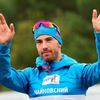

Biography
Dmitry Malyshko says that only after winning the home Olympics in 2014, sports began to bring pleasure, and biathlon is not perceived as a job where something needs to be proved. However, the post–Olympic season is the worst in his career, such an assessment was given by the athlete himself, and he still had to win a place in the sun.
Then there was a performance against the head coach, the transition to an individual training schedule. No matter how the circumstances develop, Malyshko is looking for advantages in everything, and criticism is such a thing that you can't hide from.

Childhood and youth
Dmitry was born in the Leningrad region, in a city called Sosnovy Bor. As a preschooler, the boy constantly disappeared in the yard, played football, basketball with friends, rode bicycles, but did not attend any sports sections until the age of 8. When Dima went to the 2nd grade, his stepfather took him to the Youth Sports School, which specialized in preparing children for biathlon.
Training from the first day fell in love with the restless boy. However, at first Dima was much more attracted to shooting, and skiing receded into the background. But over time, when he got stronger and was able to fully master the skiing technique, he took the first roles in junior and junior competitions as a sprinter.
Thanks to his speed and excellent technique, Dmitry won a bronze medal at the Winter Olympics in Saransk in 2008 and got "on the pencil" to the coach of the youth team.
At the same time, the young man moves to St. Petersburg, begins to study in a stronger team. But the global financial crisis hit the biathlon federation the hardest at that moment. Athletes had to buy almost all the equipment at their own expense. Plus, Dmitry, according to him, did not feel that they were really interested in him.
And the guy commits an act, because of which the public almost lost a biathlete: he leaves the sport. Since Dmitry Malyshko is an economist by education (graduated from the St. Petersburg State University of Service and Economics), he got a job at the bank of the Northern Capital.
Malyshko was returned to professional sports by the famous former Soviet biathlete Anatoly Alyabyev, who promised that the federation would find an opportunity to provide some financial assistance to the athlete. But Dmitry was convinced not at all by financial support, the amount of which was not that big, but by the fact that the famous athletes and coaches of the national team see him as a prospect.
Biathlon
Dmitry Malyshko, whose height at that time was already 184 cm and weight – 77 kg, made his debut in adult competitions in 2009. And at the end of the season, he already made his own contribution to the team's success: at the European Championships in Estonia, he contributed to winning a silver medal in the relay.
Soon, however, the biathlete faced a new problem – the medical commission found a heart complication in the young man. There was no risk for a quiet life, but if Dmitry wanted to continue performing at a high level, where physical exertion is beyond the limit, surgical intervention was required.

At the beginning of 2011, Dmitry decided to have an operation, and in February he starts training. Moreover, at the Russian Championship in April of the same year, Malyshko takes 2nd place. By the end of the year, the athlete will have a gold medal from the Swedish IBU Cup and a silver in the relay from the World Cup in Austria.
The results shown by Malyshko in 2012 are unstable. At the World Cup, Dmitry won silver and bronze in the pursuit race from 2 stages, bronze in the relay, four more times he stopped a step away from the podium. And the sprint and individual distances were not submitted to the biathlete, the surname of the Russian appeared in the second and sixth tens. But 2013 started with 3 gold and 1 silver medals at the stage in Germany.
Dmitry initially showed himself to be a great skier who knows how to develop high speed, so he became a mandatory participant in relay competitions. In the following years, the athlete repeatedly rose to the podium at the European Championships and World Cups.
Dmitry Malyshko did not disappoint Russian biathlon fans at the home Olympics in Sochi. In the relay, the athlete showed a good time and together with Anton Shipulin, Evgeny Ustyugov and Alexey Volkov won the main prize. The performance at the Sochi Olympic Games became a highlight in Dmitry Malyshko's sports biography.
In 2016, Dmitry Malyshko, together with the Russian national team, participated in the World Cup in Holmenkollen, located 20 minutes from the Norwegian capital. In the individual race, the athlete took 64th place. At the end of January of the same year, at the World Cup relay in the Italian city of Anterselva, Malyshko achieved 1st place, in November he became the second in the 10-kilometer sprint at the IBU Cup.
In 2017, he received a bronze medal in the World Cup, at the stage held on the Apennine Peninsula. Participation in the sprint in the Slovak Rally brought the biathlete another 3rd place. In the overall World Cup standings of the 2016/2017 season, Dmitry Malyshko was listed at number 44, so he was not among the participants of the biathlon team at the IBU Cup.
At the Russian Summer Biathlon Championship, which took place in September, Dmitry again received 3rd place in the team relay. The coaching staff of the national team announced that, provided his personal result improves, he will be included in the team at the IBU Cup. However, the lack of stability did not allow the athlete to enter the World Cup, and then deprived him of a place in the national team.
In the 2017/2018 season, Malyshko trained separately from the main team, participated in the European Championship and the IBU Cup, in the latter he won the 10 km sprint and became the second in the pursuit race. At 2 stages of the World Cup Dmitry replaced Alexander Loginov, in the relay at the same tournament he won a bronze medal. The individual training of the shooting skier was funded by the Biathlon Federation of St. Petersburg, at the same time the idea came to invite Anatoly Khovantsev, who revealed the talent of Ekaterina Yurlova, to the post of coach.
The challenge to the World Cup caught Malyshko and Khovantsev at the training camp in Sochi. We were going to Finland in a hurry to have time to acclimatize. The equipment was completed on the spot. The rifle was borrowed by Finnish biathlete Kaisa Myakarainen, but then the weapon had to be changed again. The skis were delivered from Tyumen, they managed to get right to the start of the stage in Kontiolakhti.
Dmitry was not allowed to attend the Olympics in Korea by the International Olympic Committee, despite the fact that Malyshko had no complaints regarding compliance with anti-doping rules.
The coaching staff included Dmitry in the team that competed in the mixed relay at the Finnish World Cup. The team consisting of Malyshko, Maxim Tsvetkov, Daria Virolainen and Ulyana Kaisheva finished fourth. As TV commentator Dmitry Guberniev noted later, victories will come when a truly friendly team appears, and defeats will be experienced together, as well as victories. After all, at the finish Dmitry became the only one of the Russians who came up to greet Tsvetkov who completed the distance.
Malyshko blamed the failure in the sprint and the pursuit race at the stage in Norway on the wrong selection of skis. But in the relay, which completed the team races of the season, the Russian men's team won bronze. Dmitry finished the season with a victory at the 15-kilometer distance from the mass start in the Russian championship, entered the top ten in the pursuit and sprint.
Awards and achievements
2010 – silver medal of the European Championship (in relay)
2013 – three gold and three silver medals of the World Cup stages
2014 – gold medal of the Olympic Games (in relay), gold and bronze medal of the World Cup stage
2015 – three gold (in the relay) and a bronze medal (mass start race) of the World Cup stages
2016 – gold medal of the World Cup stage (in relay)
2017 – bronze medal of the World Cup stage (in relay)
2018 - bronze medal of the World Cup stage (in relay)


