
Other attributes
DEVICE AND PRINCIPLE OF OPERATION OF THE COMMON RAIL SYSTEM
Scheme and details of the system

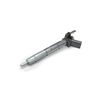
This common rail injection system uses piezoelectric injectors.
The nozzles are controlled by an actuator based on the use of a piezoelectric element. The switching speed of such a mechanism is many times higher than that of a nozzle with a solenoid valve.
In addition, the mass of the movable needle in the atomizer of the piezoelectric nozzle is about 75% less than that of the nozzle with an electromagnetic drive.
This provides piezoelectric injectors with the following advantages:
* short switching time
* the ability to produce several injections during the working cycle
* injection dosage accuracy

High pressure 230-1800 bar.
Injector return pressure, 10 bar.
Pressure in the pressure line, Pressure in the return line.
1. Priming fuel pump.
Carries out a constant pumping of fuel into the pressure line.
2. Fuel filter with preheat valve.
The preheating valve prevents clogging of the filter by crystallizing paraffins at low ambient temperatures.
3. Additional fuel pump.
Supplies fuel from the pressure line to the fuel pump.
4. Mesh filter.
Protects the high pressure pump from foreign particles.
5. Fuel temperature sensor.
Measures the current fuel temperature.
6. High pressure pump (TNVD).
Creates the pressure necessary for the operation of the injection system.
7. Fuel metering valve.
Regulates the amount of fuel to be supplied to the high pressure accumulator.
8. Fuel pressure regulator.
Regulates the fuel pressure in the high pressure line.
9. Pressure accumulator (fuel rail).
Accumulates under high pressure the fuel required for injection into all cylinders.
10. Fuel pressure sensor.
Measures the current fuel pressure in the high pressure line.
11. Pressure reducing valve.
Maintains pressure in the return line of the injectors of the injection system at 10 bar. This pressure is necessary for the operation of the injectors.
12. Nozzles.

Common rail injection system
The common rail injection system is a fuel injection system for high pressure accumulator diesel engines. The term "Common Rail" means "common beam or rail" and is used to refer to a common fuel rail
(pressure accumulator) for all injectors in a row of cylinders.
In this system, the injection process is separated from the process of creating a high pressure. The high pressure required for the injection system is generated by a separate high pressure fuel pump (high pressure fuel pump).
Fuel under high pressure accumulates in a pressure accumulator (fuel rail)
and through short high-pressure fuel lines to the injectors.
The common rail injection system is controlled by the Bosch EDC engine management system.
The common rail injection system has great potential for adjusting the pressure and injection parameters in accordance with the operating mode of the engine. This creates good prerequisites for meeting the ever-increasing demands on the injection system in terms of improved economy, reduced exhaust emissions and engine noise.

Introduction
The merits of the common rail fuel injection architecture have been recognized since the development of the diesel engine. Early researchers, including Rudolf Diesel, worked with fuel systems that shared some of the essential characteristics of modern common rail diesel fuel injection systems. For example, in 1913, a patent for a common rail fuel injection system with mechanically driven injectors was issued to Vickers Ltd. from Great Britain [McKechnie 1913]. Around the same time, another patent was issued in the United States to Thomas Guff for a fuel system for a spark ignition engine with cylinder direct injection using electrically actuated solenoid valves. Fuel consumption was measured by monitoring the time during which the valves were open [Gaff 1913].] . The idea of using an electrically operated injection valve on a common rail diesel engine was developed by Brooks Walker and Harry Kennedy in the late 1920s and applied to a diesel engine by the Atlas-Imperial Diesel Engine Company of California in the early 1930s. [Walker 1933] [Berman 1962] [Knecht 2004] [Aird 2001].
Work on modern common rail fuel injection systems was started in the 1960s by the Societe des Procedes Modernes D'Injection (SOPROMI) [Huber 1969]. However, it will be another 2-3 decades before regulatory pressure spurs further development and the technology becomes commercially viable. SOPROMI technology has been evaluated by CAV Ltd. in the early 1970s, and it was found to offer little advantage over existing PLN systems in use at the time. Significant work was still required to improve the accuracy and capabilities of solenoid drives.
Further development of common rail diesel systems began in the 1980s. By 1985, Industrieverband Fahrzeugbau (IFA) from the former East Germany had developed a common rail injection system for their W50 truck, but the prototype was never put into series production and the project was abandoned after a couple of years [Sachsisches Industriemuseum 2010]. Around the same time, General Motors was also developing a common rail system for its light IDI engines [Williams 1982]. However, with the cancellation of their light diesel engine program in the mid-1980s, further development was halted.
A few years later, in the late 1980s and early 1990s, engine OEMs initiated a number of development projects that were later taken up by fuel injection equipment manufacturers:
Nippondenso developed a common rail system for commercial vehicles [Miyaki 1988] [Miyaki 1991], which they purchased from Renault and which was put into production in 1995 in the Hino Rising Ranger trucks.
In 1993, Bosch - perhaps due to some pressure from Daimler-Benz - acquired UNIJET technology, originally developed by Fiat and Elasis (a Fiat subsidiary), for further development and production [Stumpp 1996] . The Bosch passenger car common rail system was introduced in 1997 for the 1998 model year Alfa Romeo 156 [Jost 1998] and the Mercedes-Benz C-class.
Shortly thereafter, Lucas announced Common Rail contracts with Ford, Renault and Kia, with production beginning in 2000.
In 2003, Fiat introduced a next generation common rail system capable of 3-5 injections/engine stroke for the Multijet Euro 4 engine.
Further information on the history of Common Rail systems can be found in the literature [Knecht 2004] [Petruzzelli 2013].
The goal of these development programs, begun in the late 1980s and early 1990s, was to develop a fuel system for a future diesel passenger car. At the beginning of these efforts, it was obvious that future diesel vehicles would use a direct injection combustion system due to the clear advantage in fuel economy and power density over the then-common indirect injection combustion system. The development objectives included driving comfort comparable to gasoline vehicles, meeting future emission limits and improving fuel economy. Three groups of fuel system architectures were considered: (1) electronically controlled distribution pump, (2) electronically controlled unit injector (EUI or unit injector) and (3) common rail (CR) injection system. While efforts on each of these approaches led to commercial fuel systems for production vehicles, the Common Rail system provided a number of benefits and eventually came to dominate as the main fuel system used in light duty vehicles. These benefits included:
Fuel pressure is independent of engine speed and load conditions. This

BMW Diesel EngineDiesel engine with common rail fuel system- This is the most modern stage in the evolution of diesel engines with direct fuel injection. Unlike traditional diesel engines with low fuel supply pressure (with in-line pumps or unit injectors), such an engine is equipped with a fuel accumulator - a ramp, where diesel fuel is supplied under high pressure (from 1350 to 2500 bar) and then distributed between electric injectors with solenoid valves or with piezocrystals inside. The latest generations of common rail systems are distinguished by the use of piezoelectric injectors to increase injection accuracy with a quantitative increase in injection phases, as well as an increase in fuel supply pressure to the rail (over 2500 bar). A variation for gasoline engines is called Direct Injection (FSI, GDI, etc.).
Story
The prototype Common Rail system was developed in the late 60s by Robert Huber in Switzerland. Further, its technology was developed by Marco Ganser of the Swiss Federal Institute of Technology in Zurich. In the mid-1990s, Dr. Shohei Ito and Masahiko Miyaki of DENSO Corporation, Japan, developed the Common Rail system for commercial vehicles and implemented it in the ECD-U2 system, which was used on HINO Rising Ranger trucks, and then sold the technology in 1995 to other manufacturers. Therefore, DENSO considers itself a pioneer in adapting the Common Rail system to the needs of the automotive industry. The championship is contested by the Italian concern FIAT, which declares the creation of the world's first car with a prototype diesel engine with direct injection in 1987 (CHROMA TDid). At the same time, the Italians are starting to work on a fully electronic diesel engine with the COMMON RAIL principle. The concept was named UNIJET 1900ss:
Prototype COMMON RAIL UNIJET 1.9
Modern Common Rail systems operate on the same principle. They are controlled by an Electronic Control Unit which opens each injector electronically rather than mechanically. This technology has been developed in detail by the joint efforts of Magneti Marelli, Centro Ricerche Fiat and Elasis. After FIAT developed the concept and basic design of the system in the early 90s (the name of the project is UNIJET), the patent for it was sold to the German company Robert Bosch GmbH in 1993 to complete the development of a mass product. Overall, this was a big miscalculation for FIAT, as the new technology became very profitable. But the Italian concern was at that time in a deplorable financial condition and did not have the resources to complete the work performed. However, the Italians first applied the Common Rail system in 1997 on the Alfa Romeo 156 1.9 JTD (the second generation of the COMMON RAIL system with MULTIJET multipoint injection) and only then it appeared on the Mercedes-Benz C 220 CDI. In 2003, FIAT applied the MULTIJET principle to the smallest 1300cc four-cylinder diesel engine at the time.
Common rail engines are used in power generation, shipbuilding and for locomotives. The Cooper-Bessemer GN-8 system introduced a modified Common Rail system that uses hydraulic control.
Principle of operation
English word COMMON RAILindicates the same high pressure in the accumulator tube (rail or rail), which is distributed to all cylinders. The design has two fuel supply pressure circuits - low pressure to the injection pump (from vacuum to 6 bar) and high pressure from the injection pump to the injectors (from 1350 to 2500 bar). Depending on the configuration, an electric submersible pump in the tank or a vacuum pump on the rear of the injection pump delivers the diesel fuel through the fuel heater and filter to the high pressure pump. The high-pressure fuel pump is driven by the engine (via a belt or camshaft) and sends fuel at high pressure to the rail. For normal operation of the system, it is not necessary to constantly maintain the highest pressure. The ramp tubes are of the same length and terminate in nozzles. The rail also has a pressure regulator. which sends the excess fuel back to the tank through the cooler. With the help of the rail pressure sensor, the Engine Control Unit (ECU) can receive information about the pressure in the rail and control it. Overpressure in the rail can be controlled by a mechanical valve that bleeds excess fuel into the return line to the tank. A distinctive feature of the SIEMENS system is the placement of the pressure control valve on the injection pump housing, and not on the ramp.
Types of control of fuel systems COMMON RAILAccording to the method of pressure control, the COMMON RAIL system can have several variations:
- Pressure control on the low pressure side using a dosing valve; By changing the duty cycle signal, the engine ECU supplies the required amount of fuel to the fuel compression area.
- Pressure control on the high pressure side with a pressure regulator; By changing the duty cycle signal, the engine ECU drains the required amount of fuel into the return line to maintain the desired pressure.
- Pressure control with a dosing valve in the low pressure circuit, and with a rail pressure regulator (Dual Control). Depending on the injection strategy and the engine operating mode, the ECU controls both the amount of fuel that is supplied for compression and the amount of fuel drained into the return line from the rail.
The choice of the right type of control is determined by the size of the engine, its power and its tasks, as well as the reasonable cost of the vehicle. The control signal to the valves can be proportional to the pressure, when the pressure also increases with an increase in the duty cycle, or it can be inversely proportional when the pressure decreases with an increase in the duty cycle. This depends on the chosen valve design and may differ on different versions of the same engine. Therefore, you should always know exactly how the valve works on a specific vehicle in order to properly diagnose its operation.
The presence of a pressure accumulator is a direct sign of the use of the COMMON RAIL system. Ramps can be spherical or cylindrical, forged or cast. Have mechanical or electrical emergency valves for draining fuel into the return line. V-shaped systems use a minimum of 2 rails per block. One with a pressure sensor, the second can have a pressure regulator. In some types, a distribution third rail was used from which fuel is supplied to the other two (Land Rover, Jaguar, Ford). The main task of the ramp is to be able to maintain the maximum possible fuel pressure without collapsing, and evenly distribute the fuel over the injectors.
The COMMON RAIL system uses injectors of a certain design. On the first generations, nozzles were used with an electric solenoid valve that controls the lifting of the needle in the atomizer. Due to the need to control the injection at a higher pressure, piezo injectors have been used. Recently, some manufacturers are returning to the technology of solenoid injectors, since their response time to ECU commands has been made shorter, they can be easily sorted out and restored, and they are cheaper to manufacture.
Sensors
The main sensors used in the system are the rail fuel pressure sensor, air flow sensor, camshaft and crankshaft sensors, engine, fuel and intake air temperature sensors, accelerator pedal position sensor, fuel heating system sensor.
Activators
The solenoid valves in the common rail system must respond within half a second: these are the fuel injectors, the rail pressure regulator valve, the turbocharger valve and the exhaust gas recirculation valve.
nozzles
The injectors are turned on at the command of the controller - the EDC unit (ECU) by means of a magnetic solenoid or a piezoelectric element. The hydraulic pressure force allows the nozzle to be opened and closed, however, activation takes place from the control unit. If the nozzle is with a piezocrystal, then under the influence of a magnetic field, the crystal increases in its physical dimensions in it, instantly changing the hydraulic balance inside the nozzle and thereby raising the needle. In the Piezo Inline nozzle, the crystal is close to the needle and therefore does not use mechanical parts to lift the needle. Early systems used dual injection - pilot and main to prevent detonation. In modern systems, up to seven injection phases are used, in the most modern ones with support for the Euro 6 standard, up to nine. Each nozzle is manufactured and tested in the laboratory, where she is assigned a specific code according to the measured data of her work. After replacing the injectors, the code must be written into the memory of the control unit using a scanner.
Reasons for the displacement of traditional diesel engines
Ability to meet stringent emissions regulations, less engine noise, smaller overall dimensions, simple design, easy diagnostics and maintenance, cheaper component manufacturing.
Portal tasks
This portal was created by enthusiasts and followers of COMMON RAIL direct injection diesel technology. On the pages of our website you can get acquainted in more detail with the different types of systems that dominate modern cars, learn about the equipment with which you can quickly, efficiently and inexpensively diagnose faults and subsequent repairs. Many pictures and illustrations are interactive. Hover your mouse over and click on the item's image or photo for even more information. On the pages of the portal, we post news and videos describing various systems and techniques for repairing injectors, valves and other components. We also conduct regular training seminars and courses for specialists in the repair of diesel systems of the COMMON RAIL type. If you have any questions,
Common Rail today
TDI COMMON RAIL
Currently, the most common are four types of systems, named after their manufacturer. These are BOSCH, DELPHI, DENSO and SIEMENS, which was also identified as VDO, and is now positioned as CONTINENTAL. Each car manufacturer has its own abbreviation for marketing purposes, which stands for both the COMMON RAIL system and its individual elements:
- BMW : D-engines (also used by Land Rover Freelander as TD4)
- Cummins and Scania : XPI (Joint Development)
- Cummins : CCR (Cummins pump with Bosch injectors)
- Daimler : CDI (for Chrysler and Jeep vehicles - CRD)
- Fiat : Fiat, Alfa Romeo and Lancia - JTD (also called MultiJet, JTDm, Ecotec CDTi, TiD, TTiD, DDiS, Quadra- Jet)
- Ford Motor : TDCi Duratorq and Powerstroke
- General Motors : Opel/Vauxhall - CDTi (manufactured by Fiat and GM Daewoo) and DTi for Isuzu
- General Motors : Daewoo/Chevrolet - VCDi (licensed from VM Motori also branded Ecotec CDTi)
- Honda : i-CTDi
- Hyundai and Kia : CRDi
- Mahindra : CRDe
- Maruti Suzuki : DDiS (produced under license from Fiat)
- Mazda : CiTD
- Mitsubishi : DI-D (new generation 4N1 with up to 2000 bar injection pressure)
- Nissan : dCi
- PSA Peugeot Citroen : HDI or HDi (Volvo S40/V50 uses PSA 1.6D & 2.0D engines, also uses
JTD brand)
- Renault : dCi
- SsangYong : XDi (engines are assembled under license from Daimler AG)
- Subaru Legacy : TD (since January 2008)
- Tata : DICOR
- Toyota : D-4D
- Volkswagen Group : TDI. A complete range of diesel engines with CR technology replaced the unit injector in 2005.
- Volvo : D3, D4 and D5
- Skoda : TDI