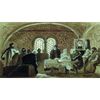

The origin of the Boyar Duma
The predecessors of the Boyar Duma, as a form of collective decision-making, can be considered veche - people's meetings, in which the majority of the inhabitants of the settlement participated.
However, the veche differed from the Boyar Duma in its composition – the entire population of the city participated in it, mostly non-class people, ordinary people. That is why the Veche is considered one of the first forms of democracy in Russia in the X-XII centuries.
By the end of the XIV Veche disappeared in most of the territory of Russia in the century, when the Mongol-Tatar yoke was established. However, in the North-Western regions – Novgorod and Pskov – the Veche was liquidated by the Moscow princes only in the late XV- early XVI centuries.
At the same time, new advisory bodies under the prince appeared — princely dumas, which included his closest associates. At the same time, they could be called in different ways: "boyars", "prince's squad", "princely council". The composition of the princely duma was close to the composition of the Boyar Duma – it included representatives of the nobility and clergy.
Subsequently, the "princely Duma" was given the name "boyar Duma", since the boyars made up the largest number in it.
Although each territory that was part of the Old Russian state had its own boyar Duma, and the prince himself directly determined its quantitative and qualitative composition, however, objectively none of them could do without this advisory body — the prince needed loyal advisers to manage the principality.
The continuation of the princely Duma was the boyar Duma - the supreme council under the prince (since 1547 - under the tsar).
The Boyar Duma was a permanent institution, but usually decisions of higher zemstvo affairs were made not every day, but as they arose.
The boyar (princely) Duma did not play an independent role and always acted together with the tsar, representing together with him a single supreme power. Usually it consisted of boyars, elders of the city, and only in special cases representatives of the clergy were invited to it.
Initially , the following issues for discussion were assigned to the jurisdiction of the Boyar Duma:
war and peace,
foreign relations (international treaties, trade, etc.),
domestic policy (adoption of legislative acts, etc.),
religious issues, etc.
All contracts were concluded on behalf of the prince and his "bright boyars".
Public opinion highly valued the boyar Duma, considered its existence a necessary condition for good princely governance.
Preliminary discussion of any issues of the prince with the boyars was taken for granted. However, if the prince made a decision alone, without consulting the boyar Duma, then the boyars considered it right to refuse him assistance and assistance.
The Boyar Duma is a legislative and judicial body under the tsar, consisting mainly of representatives of noble families, which participated in the adoption of important national decisions.

Functions and competence of the Boyar Duma in the XIV-XVII centuries.
The functions and competence of the Boyar Duma have changed in various periods of history, as has the nature of relations with the tsarist government.
Initially, the boyar class at the Prince's court served as the Prince's usual permanent council for zemstvo and military administration. This council included not only boyars, but also "elders of the city", and representatives of the clergy.
XIV-XV centuries, in the so-called "tsarist period", after the overthrow of the Mongol-Tatar yoke, the interests of the princely power and the boyar Duma coincided – the combined forces of the two bodies were needed for state-building and unification of the people.
During this period of time, the Boyar Duma becomes a natural and necessary element of the state-power system. The composition of the Duma has become permanent.
At the same time, a distance appeared between the tsar and the Boyar Duma compared to the "princely period", since the relationship between these authorities began to be more official.
In the XV century, the concept of "boyar" turned into a title and a duma rank, which the tsar gave to a few elected advisers. The boyars gradually became a class, a royal synclite - an assembly of high dignitaries of the type of the Western aristocracy.
From a legal point of view, at this time the functions of the Boyar Duma were not yet clearly defined. In the Court Book of 1497, only the judicial function of the Boyar Duma was mentioned: "Judge the court of the boyars and the circumnavigators. And at the court of being with the boyars and the deacons of the circumlocution."
The tsar and the Boyar Duma were the highest judicial instances — "the sovereign said, and the boyars were sentenced," and the documents they accepted were called "sentences of the tsar with the boyars."
Other powers of the Duma were based on customary law and traditions. In addition to judicial powers, the Boyar Duma solved important issues of domestic and foreign policy.
At the end of the XV century. in Russia, localism was approved, in which the order of distribution of official places was carried out based on the ancestral origin and official position of the person's ancestors. This had a negative impact on the management of public affairs, as abuse of power, corruption and self-will of the boyars in state politics began to flourish.
There were constant feuds and internecine struggle between the boyar clans, especially intensified during the period of Ivan IV's infancy, when an open "hunt" for the royal throne was conducted.
Subsequently, Ivan IV began to wage an active struggle, both with the boyars' claims to power, and with the locality itself, since it made it difficult for competent and loyal service people to come to the administration. During this period, Ivan the Terrible began to appoint people loyal to him to positions in the Boyar Duma by his direct decrees, and the boyars were subjected to severe repression.
In the XVI century, a new stage of development of the Boyar Duma begins, which turns from a feudal curia under the prince into a state body of a class-representative monarchy.
During this period, on the one hand, the importance of the Boyar Duma as the supreme council under the tsar remains: "a sovereign without a Duma and a Duma without a sovereign were equally abnormal phenomena." On the other hand, the Duma began to limit the power of the tsar.
In the Judicial Code of 1550, the legislative status of the Boyar Duma is stated directly and unequivocally: "The Tsar and Grand Duke Ivan Vasilyevich of All Russia with his brothers and son of the boyars laid this Judicial Code."
Managerial functions in the Boyar Duma were carried out through a system of temporary boyar commissions. Secret affairs were decided by the Inner Duma, consisting, as a rule, of four boyars.
The Boyar Duma retained important functions in the judicial sphere. As before, the tsar and the Duma were the highest judicial instances. As a court of the highest instance, the Boyar Duma reviewed decisions made by orders and local courts.
The jurisdiction of the Duma in the first instance included:
political crimes;
official crimes and misdemeanors;
crimes committed by noble boyars, including those who were part of the Boyar Duma itself;
crimes of clerks and other servants of orders, if they concerned violations of the order of justice (so-called parochial disputes).
Political crimes were referred to the Boyar Duma by the sovereign himself: "... in these cases, the judicial activity of the Boyar Duma may be called extraordinary."
The important powers of the Boyar Duma were also in matters of foreign policy: the Duma drafted and sent diplomatic letters to various states, heard embassy replies, participated in the hearing of embassy cases, accepted "sentences" regarding war and peace.
In the XVII century, fundamentally new relations were already established between the tsarist government and the Boyar Duma.
After the death of Boris Godunov, the role of the Boyar Duma increased for a while. In 1610, as a result of the struggle between the factions of the ruling class, Tsar Vasily Shuisky was overthrown from the throne. The fullness of power temporarily passed to the Boyar Duma. For some time, the state was actually ruled by seven influential boyars, which in history was called the Seven Boyars.
During the Time of Troubles (1598-1613), the Boyar Duma played a key role in all events of national importance. For example, it is known that the Boyar Duma did not allow the violation of the treaty of "eternal peace" with Sweden, when False Dmitry I, trying to fulfill his promises to the Polish king, ordered to prepare troops for a campaign against the Swedes. The impostor was forced to submit to the Duma, because it had great authority in the country.
The Boyar Duma, as before, remained a political institution that determined the state and public order and directed it.
In the middle of the XVII century. there is a normative consolidation of the powers of the Boyar Duma in the Cathedral Code of 1649. However, in general, the powers of the Boyar Duma are limited compared to the previous period.
So. under Tsar Alexei Mikhailovich, the Boyar Duma lost the right to independently pass acts that had the force of law. The boyar sentences began to have the significance only of the draft law, which was still to be considered and approved by the tsar.
In the Council Code of 1649, it was stated that "the boyars and the circumnavigators and the duma people were sitting in the regiment, and by the sovereign's decree, the sovereign did all sorts of things together" (Article 2, Chapter X of the Council Code of 1649).
The Boyar Duma continued to be the highest judicial and appellate instance after the tsar. The chapter of the Council Code began with the following words: "The trial of the Sovereign Tsar and Grand Duke Alexei Mikhailovich of All Russia, judged by the boyar and the okolnichy and the duma people and the dyak ..." (v. 1, Chapter X).
Another feature testified to the decline of the Duma's role in the life of the state in the last third of the XVII century – the emergence of such a thing as a "nominal decree", i.e. a legislative act drawn up only by the tsar, without the participation of the Boyar Duma.
The centralization of state administration under Tsar Alexei Mikhailovich in the XVII century also affected the status of the Boyar Duma — during this period, many of its members were simultaneously judges (i.e. heads) of orders, i.e. duma officials controlled almost all orders. So, at the beginning of the XVII century. The Duma directly controlled more than 80% of orders.
Thus, from an organ of the boyar aristocracy, the Duma, in fact, turned into an organ of the command bureaucracy, which weakened the independence and importance of this body.
In the future, with the transition of Russia to absolutism in the second half of the XVII century. the importance of the Boyar Duma is even more weakened. Under Peter I, the number of Duma meetings was sharply reduced, and its quantitative composition was gradually decreasing.
However, Peter I did not adopt a special law on the abolition of the Boyar Duma, he simply stopped granting duma ranks.
For some time, meetings with the boyars continued in the so-called Near Chancery— a permanent body that performed the functions of the personal chancery of the tsar.
The last mention of the meetings of the Boyar Duma dates back to 1700 . In the XVIII century, the successors of the Boyar Duma were the "Council of Ministers", the Reprisal Chamber of the Boyar Duma and, of course, the Senate.

The composition of the Boyar Duma
Initially, the main principle of forming the composition of the Boyar Duma was not the competence of the boyar who was part of it, but his genealogy, genealogy. As a rule, the Duma consisted of descendants of former appanage princes, for example, representatives of such influential noble boyar families as Dolgoruky, Shuisky, Vorotynsky, etc.
By their origin, some clans of boyars could compete for pedigree with the royal dynasty, since they also had an origin from the Rurikovich. This could give them legal grounds in case of suppression of the dynasty to claim the royal throne. And history knows the boyar behind-the-scenes intrigues and feuds because of the desire to take possession of it.
Such a situation could not suit the tsar, since it was a threat to his autocratic power. Therefore, in the future, especially under Ivan IV, the tsar became more independent in terms of forming the composition of the Boyar Duma. At the same time, the composition of the Boyar Duma was constantly changing, which was due to various reasons, including falling out of favor with the tsar.
However, almost until the end of the XVII century. the tendency to appoint boyars to the Duma by the sovereign, mostly from noble families and according to a certain turn of parochial seniority, persists.
But since the XVI century, "low-born people" began to appear in the Duma, that is, non-noble family, as a rule, noblemen-landowners who proved personal loyalty to the sovereign. They received the title of "duma nobles". This trend was especially intensified during the period of aggravation of the struggle between the tsarist government and boyar groups. For example, everyone knows that Ivan the Terrible led an active struggle with the noble boyars.
The stratification of the boyars into Duma ranks and palace dignitaries led to duplication of their duties, which gave rise to intrigues, bribery, and created prerequisites for corruption. For example, V.O. Klyuchevsky wrote that the bed-keeper "did not want to go to the ward and sit with the boyars."
Since the XVI century, the main core of the Boyar Duma began to be the chiefs of orders (central government bodies). However, such changes in the composition of the Boyar Duma caused discontent among the titled nobility, who argued, "these new ones are not suitable for our fathers and for slaves." However, it was "these new ones" who performed the most burdensome and troublesome duties in the Duma.
So gradually the composition of the Duma ranks was formed:
boyars (advisers) — the first Duma rank,
ringleaders, treasurers, printers (keepers of the royal archive), duma nobles;
the parliamentary clerks, who originally was in charge of clerical chores (were the speakers at the meetings of the Council for the Affairs of his orders, were given different reference, representative of the views of the Duma for the formulation of sentences, etc.).
In the composition of the Boyar Duma was the so-called technical staff to officials who were not directly part of it, but fulfilled the functions that support the activities of the Tsar and the boyars, for example, brought viands to the table of the Emperor.
In terms of number, the composition of the Duma at various times averaged from 20 to 60 people. However, meetings, as a rule, did not take place in full. For example, there is a case of a decision by the Boyar Duma in the number of 2 people. This was due to the fact that many boyar ranks often went to their estates to restore order there, participated in military campaigns, served in the capital's orders or simply ignored meetings in the Duma.
Order and procedure of meetings of the Boyar Duma
According to the historical information that has come down, a certain order of meetings was established in the Boyar Duma. So, it is known that in the summer, meetings began with sunrise and lasted from 1 to 6 hours.
As a rule, cases were discussed on Monday, Wednesday and Friday, however, urgent ones could be held on any day and at any time, and even at night, which is why some foreigners had a distorted idea of the practice of "night vigils" in the Boyar Duma.
Meetings were not held on weekends and church holidays, as well as during Holy Week.
If the tsar sat together with the boyars, they accompanied him throughout the day: they attended church together with the tsar, dined together, etc.
As a rule, the meetings in the Boyar Duma were peaceful, but sometimes there were shouts and even physical abuse. However, in the presence of the tsar, a decent atmosphere of unhurried discussion of issues was always observed.
The meetings of the Boyar Duma were held as a general rule in the Front, Golden or Dining Chamber of the Kremlin, but there could also be visiting meetings, for example, in the villages of Izmailovo or Kolomenskoye.
Sometimes the meetings of the Boyar Duma took place with the joint participation of the higher clergy, in the XVI century. they were referred to as "cathedral".
Initially, the Boyar Duma considered all issues at its meetings, ranging from important state issues to insignificant private ones.
Then this order was changed: many issues were submitted to the orders whose competence it was to resolve. The Duma began to resolve only the most significant issues.
Current affairs were considered at duma commissions chaired by the boyar who initiated the consideration of the issue.
Questions and cases for discussion were submitted to the Duma in various ways:
1) the sovereign himself could bring them up for discussion;
2) received in the form of reports from orders;
3) they came in the form of petitions.
The sessions began with the report of the Duma clerk or the reading of the petition, and this occupied most of the discussion. The minutes of the meetings were kept.
The decisions of the current affairs of the Boyar Duma could be issued by two types of acts:
"fixing" is a more important document in its status on general management issues, which was signed by all duma clerks;
"litter" - the decision of the Duma on matters of a private nature, was signed by one duma clerk.
In the most important state and judicial cases, the end of the discussion was expressed in the adoption of the decree of the tsar and the sentences of the Boyar Duma.
When the tsar was not absent from the Duma meetings, the first place belonged to the oldest boyar in the fatherland, and then the name of that boyar was mentioned in the verdict.
The text of these documents began with the words: "The Tsar, the sovereign, the Grand Duke indicated" or "The Great Sovereign, after listening to this report, indicated, and the boyars were sentenced."
These formulas perfectly illustrate the peculiarities of the relationship between the two authorities — the tsar and the Boyar Duma - in the mechanism of state administration: the tsar "indicated", i.e. gave an order, and the Duma "sentenced", i.e. made a decision on the tsar's instructions.
It should be noted that the formulations of these phrases of the beginning of the texts with minor changes have existed for more than 100 years.
Sometimes the Boyar Duma had the authority to make independent decisions — boyar sentences, which could take the form of a law without a royal decree: "All the boyars at the top were sentenced." This was possible in the case of obtaining special powers for that, for example, "by decree of the sovereign," or when the tsar was away, or during the interregnum.
In terms of legal force, the boyar sentences were equal to the royal decrees. In the instructions of the sovereign to the Duma, the expression was always used: "to fix his great sovereign's decree," "to fix his great sovereigns' decree," etc.
The boyar sentences dealt with cases of feudal land ownership, serfdom, financial, tax policy and other spheres of state activity, as well as private issues.
The boyars' sentences were distinguished by casuistry. There was no unified form of sentences. Sentences could create new norms, cancel old ones, make additions to legislative provisions, and also be examples of case law that were taken into account when considering similar cases.


