Other attributes
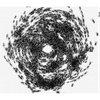
Ant mill is a phenomenon in which a group of blind army ants separated from their main group begin to walk behind one another following pheromones so their path forms a circuit or a continuously rotating circle that they follow until they die of exhaustion. Ant mill is sometimes referred to as army ant death spiral. The phenomenon is due to the self-organizing structure of ant colonies, where each ant follows the ant ahead. An ant mill was first described in 1921 by explorer and naturalist William Beebe. This ant mill had a 1200 ft circumference, which took each ant 2.5 hours to make one revolution. Similar phenomena have been observed in caterpillars and fish.
Army ants do not have eyes and they rely of scent trails left behind by themselves or other ants for choosing their direction of travel. Pheromone trails are created when an ant finds food, collects a piece, and goes back to the nest. Pheromone trails communicate the location of the food source to other ants. Ants searching for food stop random searching when they get to the pheromone trail and follow the trail to the food source. An ant mill can be created by diverting a few ants into an enclosed space where they are likely to loop back on their own scent. For example, ants can be trapped in a vortex by walking on a dinner plate.
Ant mills result from a self-organizing pattern whereby after a period of disorder, a random direction is collectively selected by ants to form the circular mill, based on simple rules of motion governed by direct interactions between individuals. Ant mill, caterpillar circle, bat doughnut, amphibian vortex, duck swirl and fish torus all describe rotating circular animal formations or collective vortex behaviors. Collective vortex behaviors can arise from the following mechanisms: attraction to a local stimulus, indirect self-organization based on stigmergy, repulsion form surrounding environmental stimuli or constraints, direct self-organization by social interaction between individuals, instability induced by a gradient and accidental positive feedback by pheromones. Stigmergy is the modification of the environment by the behavior, which subsequently affects the behavior of other individuals, such as with pheromones in an insect trail. Insect mills maintain a circular path due to positive feedback since the production of a pheromone signal is enhanced by the accumulation of that pheromone in the same location.
The ant mill phenomenon illustrates a quality specific to army ants in that they have obligate collective foraging. Army ants never scout or forage as individuals. Leaderless groups always locate and retrieve prey. Army ant syndrome is a name for behavioral and reproductive traits shared by army ant species, which are defined by three characteristics: obligate collective foraging, nomadism, and dichthadiigyny. Dichthadiigyny means that the queen is highly modified to be permanently wingless and has an expandable abdomen for egg production. The complex array of behavioral and reproductive adaptations of army ants originated once during the course of evolution and has been maintained for more than 100 million years of evolution. Circular milling is thought to be an evolutionary price for maintaining an ecologically successful and stable strategy of collective foraging.
Biological systems that build transport networks, such as trail-laying ants can be described in terms of reinforced random walks where the route taken by "walking" particles depends on the previous routes of other particles. Chemotaxis can be modelled by reinforced random walks whereby the walker can modify or reinforce travel along a particular path by a chemical attractant. Chemotaxis is the movement towards or away from chemical stimuli in the environment. Ants following trails of pheromones is a chemotaxis process. Chemotaxis processes also occur in angiogenesis in the expansion of tumors. Chemical agents secreted by a tumor attract neighboring endothelial cells which form blood vessels that sprout towards the tumor.
Correlated random walks take into account the property of inertia, the tendency for bodies to continue moving in the same direction. Correlation is also termed memory. Correlated random walks produce a local directional bias such that each step tends to point in the same direction as the previous one and gradually the influence of the initial direction of motion diminishes. Two basic directional forces have been proposed to influence ant motion: a chemical-gradient-induced centripetal force (reinforcement) and an inertia-related tangential force (memory/correlation). These two forces are proposed to influence a single ant caught in a spiral. The concentration of chemical is highest in the ring around the center of the spiral and fades out radially. This creates a gradient that points towards the center at each point where ants are located. The “eye” of the spiral is where no ants are located. Every ant in the configuration moves in a circular motion due to the combined effect of centripetal force and the tangential pull of inertia.
Previous random walk models of natural phenomena were previously based on memory or reinforcement. A continuous random walk model that combines memory and reinforcement was developed to replicate the army ant death spiral. The phenomenon was described by a system of diffusion-advection partial differential equations. The system includes biases of memory (correlation) in which moving particles remember their past velocities and tend to maintain them and positive reinforcement, the movement of particles up chemical gradients. A steady-state solution to the system was shown to be stable and resemble the ant mill. The model has applications in the influence of tumors on angiogenesis.
A model for the ant mill phenomenon was modelled by interpreting the ant as a random walk with a bias towards already visited directed edges, which increases with each crossing of a directed edge. The bias decreases whenever an edge is crossed in the opposite direction. Erhard and colleagues defined a directed edge reinforced random walk on a connected locally finite graph in which the walk keeps track of its past and gives a bias towards directed edges previously crossed proportional to the exponential of the number of crossings. The group found that on any finite graph that is not a tree, and on Zd with d ≥ 2, the Ant RW is eventually trapped into a directed circuit which will be followed forever, escapes to infinity and satisfies a law of large number with random limit.
Swarm is the collective behavior of many agents that increases the efficiency, and ants use pheromones to increase efficiency of foraging for food. A higher number of ants should increase the efficiency of the food search and delivery. The “pheromone-based searching algorithm” is used to solve the travelling salesman problem and for secure routing solutions in wireless mesh networks. The ant mill situation is an undesirable situation. Cheraghi et al. (2020) describe a pheromone-based search with an anti mill prevention algorithm for robot swarms. The researchers found that modification of the random walk search with pheromones is inefficient and causes ant mills. The group developed a pheromone-based search with anti mil prevention (PSAMP). Increasing the evaporation rate decreases the efficiency of PSAMP because the pheromones disappear faster.


