Other attributes
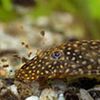
Blue catfish-ancistrus or common ancistrus (Latin Ancistrus dolichopterus) is one of the most common species of the family of ringed catfish (Loricariidae), an aquarium fish. In nature, it lives in South America, in the Amazon River.
Completely covered with polygonal bone plates. On the body there is a pair of pectoral and a pair of ventral fins. Particularly noteworthy is the rounded lower mouth and elongated lips with horn-shaped suckers, thanks to which the fish are well held in a strong current and can live in fast-flowing waters, sticking to rocks and driftwood. On the oral sucker there are horn bumps (sometimes called a "grater")[3], designed for scraping various plant and animal fouling from the surface of plants, stones and other objects. In natural conditions, this is the main source of their nutrition.
Ancistra are among the smallest aquarium catfish: their sizes range from 8 to 15 centimeters[4], but usually the length even in males does not exceed 13 cm.
In nature, it lives in South America, especially often found in the Amazon River basin. In the habitats of catfish of the Loricariaceae family, water has the following parameters most of the year: hardness - 4-5 ° dH, acidity (pH) — about 6. The current is relatively fast, the water is rich in oxygen. When kept in an aquarium, the optimal conditions are: water temperature - about 22 ° C, hardness - up to 20-25 ° dH, pH - in the range of 6.5-7.5. At least a weekly replacement of 1/4 of the old water with fresh water is required.
When keeping catfish in an aquarium, it is important to maintain the correct light mode, consisting of two phases equal in time — dark and light. Between these phases, if possible, a period of twilight lighting should be created (about 30-40 minutes) — at this time the catfish are most active. A low-power incandescent lamp (about 25 watts) is suitable for this, the light of which is directed at right angles to the wall of the aquarium.
Ancistra prefer shaded areas, which should be taken into account when designing an aquarium.

In the aquarium, these fish are in constant motion (most of the time, catfish-ancistra look for the remains of live and plant food at the bottom). They like to be in the flow zone created by aquarium filter pumps. It is important to remember that they can get into the filter and die there, so it is recommended to lift the outlet tube at a slightly greater distance from the bottom, or cover it with a grid.
These catfish adapt to the new conditions quite quickly, and young fish aged 2-6 months adapt faster. When purchasing fry, you should find out under what conditions they were kept, what they were fed. It is better to leave the feed and hydrochemical regime unchanged for the first week in a new place.
Ancistra, like most other catfish, belong to the category of revirny fish - males have a tendency to seize a certain territory and defend its inviolability. Several males can be kept in one aquarium only if the size of the bottom allows it and there are a large number of different shelters

Compatibility with other fish species.
Ancistra catfish behave peaceably. With irregular feeding, they become aggressive and carnivorous. In the absence of predatory fish in the general aquarium, they can even reproduce in it


