
 AirSwap

Unisocks

Unisocks

Unisocks
Unisocks is an “experimental” non-fungible token (NFT) listed on the Uniswap exchange, which represents a real pair of limited edition and dynamically priced socks that users can purchase from anywhere in the world.

What Is Unisocks (SOCKS)?
Holders of $SOCKS can sell them through the Unisocks platform anytime they want. Furthermore, it can also be used to redeem the pair of socks that the token represents.
Uniswap warns that Unisocks is one of the experimental projects on the protocol, which means that it’s very risky to invest in. Anyone with an ERC-20 compliant token can purchase SOCKS. Every time a SOCKS is purchased, its value increases, which is what is referred to as the “bonding curve” model.
Who Are the Founders of Unisocks?
The Unisocks project was launched by the Uniswap team, and first brought to the limelight during the Fluidity Summit in New York City on May 9, 2019. In keeping with the zany and envelope-pushing nature of DeFi in 2020, the Unisocks project may seem completely absurd at first glance and a game between DeFi degens. However the end goal of shifting the borders of DeFi applications is very serious indeed, much like the MEME token that transformed the world of art and NFTs last year did.
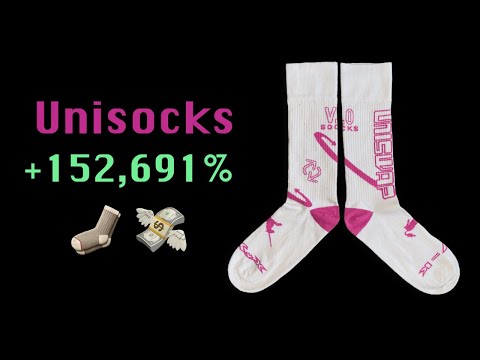
Some of its known developers are Noah Zinsmeister, Uniswap’s engineering lead, and Callil Capuozzo, Uniswap’s designlLead. Leander Capuozzo, Callil’s brother who worked with Uniswap on the design of Unishirt for their V0 birthday, also helped out on the sock design.
Dean Eigenmann, a security researcher and co-founder of the blockchain governance startup Harbour and decentralized exchange platform Dexy, performed a quick review of the Unisocks platform before it was launched.
What Makes Unisocks Unique?
Unisocks is an experimental NFT project. Unlike other NFTs in the decentralized finance (DeFi) space, $SOCKS follows a “bonding curve” model governing its price, which enables the early adopters to earn more in profit than the late majorities. This is because when there are more tokens bought and brought to the supply, its value increases accordingly.
Here’s how it works: the bonding curve model is facilitated by a smart contract, which is designed to function as an automated market maker with very specific purposes related to the tokens in circulation.
First, the model allows for the initial minting and purchase of the token based on a price determined within the smart contract. Then, the supply of the token will dictate how the token will be valued later on. If the token supply increases, the price increases consequently.
All the assets used to purchase NFTs, which is $SOCKS, in this case, are kept in a different smart contract labeled as the “reserve pool.”
Finally, in $SOCKS, the corresponding NFT gets burned, which simply means that it is removed from circulation, as soon as it is redeemed for a real pair of socks.
How Is the Unisocks Network Secured?
Unisocks runs on top of the Ethereum blockchain, just like its parent platform, Uniswap. It follows the ERC-721 token standard for Ethereum-based NFTs. This means that Unisocks’ security rests on the second-largest blockchain network, Ethereum, which currently uses a dual PoW and PoS consensus mechanism.
